
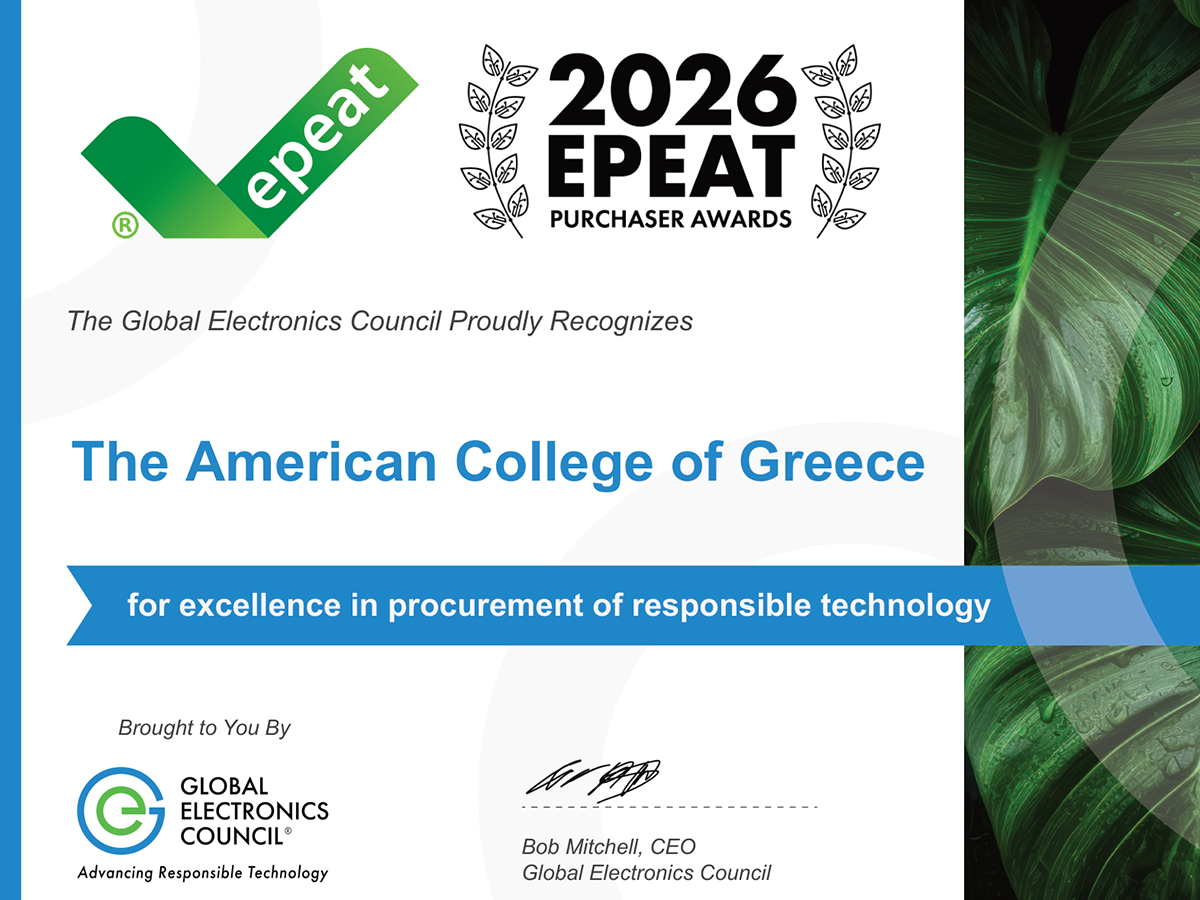
The American College of Greece (ACG) has been named a 2026 EPEAT Purchase Award winner by the Global Electronics Council (GEC), marking the fourth consecutive year of this international recognition.
Recognized across two product categories – Computers & Displays and Imaging Equipment – ACG joins organizations from the educational, healthcare, nonprofit, finance, and government sectors in excellence in the sustainable procurement of technology.
The EPEAT Purchaser Awards recognize institutions that prioritize EPEAT-registered products through their purchasing policies and practices. Managed by GEC, a non-profit organization, the EPEAT eco-label helps organizations to efficiently address the environmental and social impacts of electronics, such as computers, printers, servers, etc., throughout their lifecycle.
At ACG, EPEAT requirements are incorporated in purchasing contracts, helping ensure that vendors only provide electronics that meet strict sustainability criteria. Compared with products that do not meet these criteria, EPEAT-registered electronics are more energy-efficient, contain fewer hazardous substances, are designed to last longer, and are easier to recycle. What is more, EPEAT criteria also address labor and human rights considerations across the supply chain.
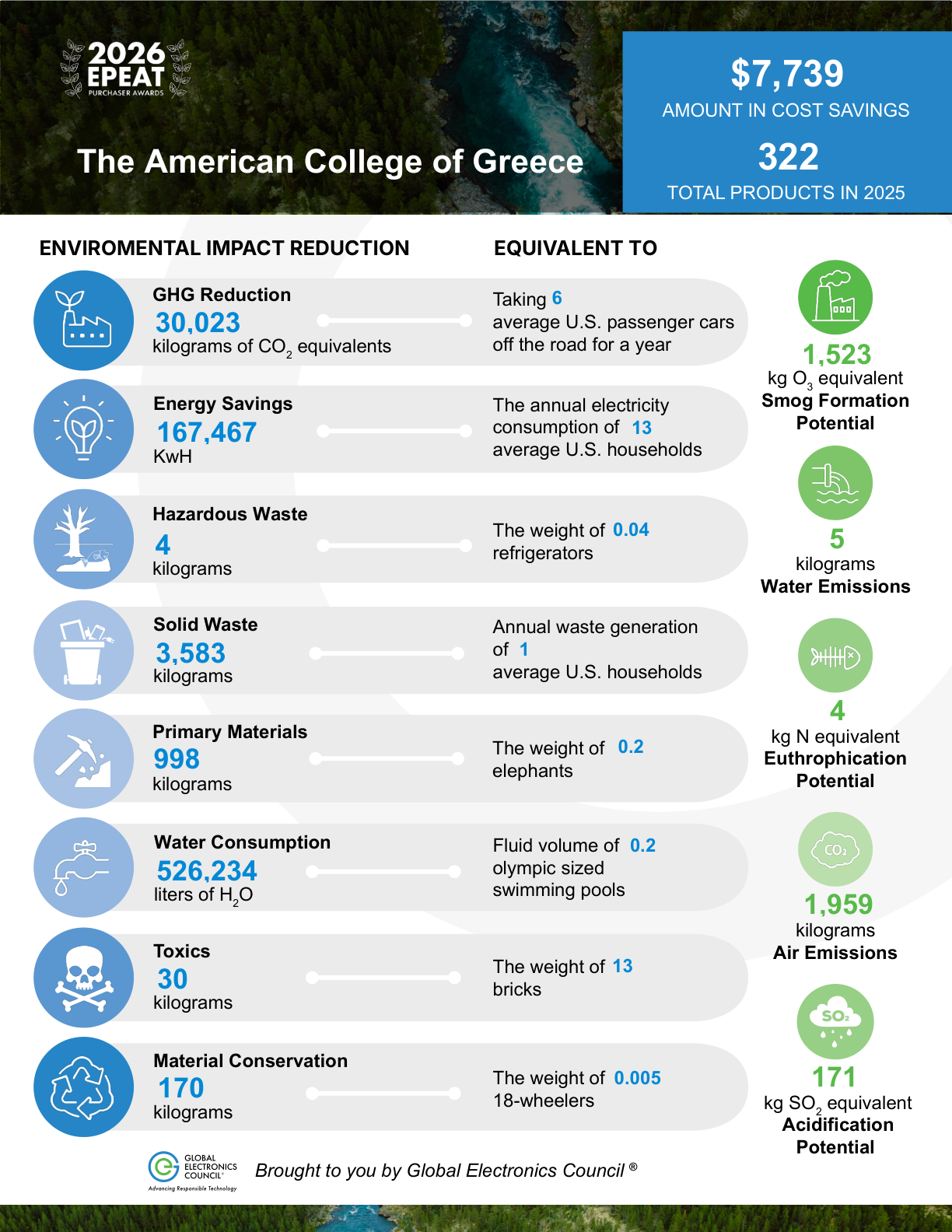
In 2025, ACG purchased 322 such products, generating measurable financial and environmental benefits, including estimated savings of US$7,739, also saving enough energy to power 13 average U.S. households for a year and reducing greenhouse gas emissions equivalent to taking six average U.S. passenger cars off the road for one year.
The infographic below, provided by GEC, presents the full impact of last year’s electronics purchases.
“ACG’s fourth consecutive EPEAT Purchase Award demonstrates that sustainable procurement is not a one-time achievement, but a continuing institutional commitment. Every purchasing decision gives us an opportunity to reduce environmental impact and support a more responsible electronics industry. I was especially honored to contribute to the Global Electronics Council committee involved in developing EPEAT sustainability criteria for refurbished notebooks, helping bring the perspective of higher education into an important international standard-setting process”, shared Rania Assariotaki, ACG Sustainability Director, Office of Sustainability – Public Affairs.