
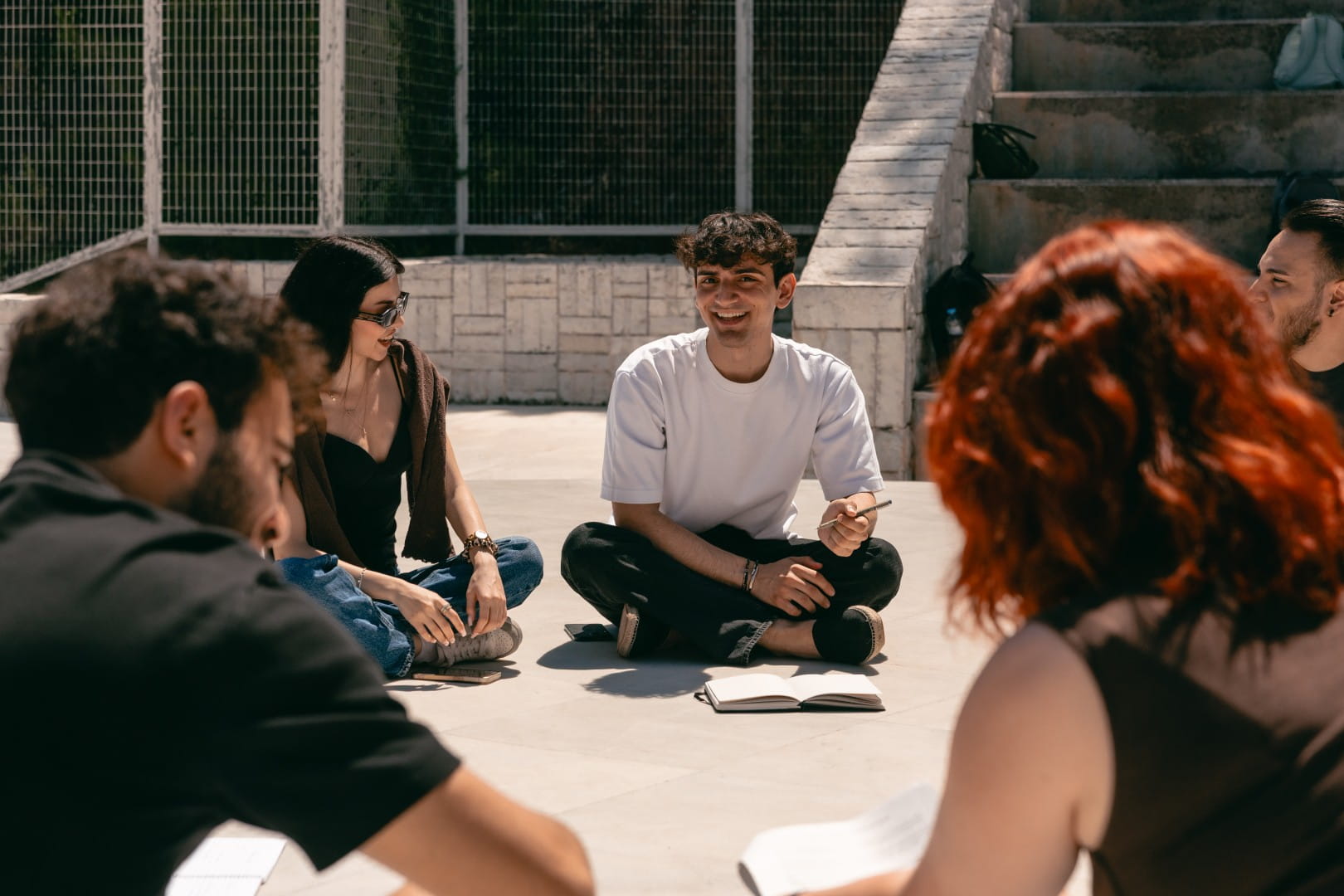
The Liberal Education program is part of each and every undergraduate major at Deree and is required of all students pursuing an ACG undergraduate degree. Generally students begin their studies at Deree by enrolling in Liberal Education courses as well as a few major courses.
Note: Courses designated as BL or OL are not approved for students who are eligible for US Federal Financial Aid.
The Liberal Education curriculum, a key component of US higher education, is required of all students, irrespective of their chosen field of study. Liberal education aims to develop broadly transferable intellectual, personal, and civic skills that enable individuals to thrive in complex, rapidly changing environments, by placing emphasis on the cultivation of habits of mind that support deep understanding, critical inquiry, and lifelong learning. Through sustained engagement with the humanities, social sciences, natural sciences, STEM, and the arts, students acquire the intellectual flexibility necessary to relate ideas across disciplines and to approach problems from multiple perspectives. The Liberal Education program offers cross-disciplinary pedagogy in a unified curriculum that integrates foundational academic elements with higher-order cognitive skills.
At the most fundamental level, the Liberal Education curriculum is designed to introduce students to essential fields of knowledge and skill development that support their future academic and professional success. These include training in academic writing and argumentation, professional communication, information technology and artificial intelligence, as well as scientific reasoning and quantitative literacy. The development of information literacy skills enables students to locate, evaluate, interpret, and ethically use information from diverse sources while critically assessing the opportunities, limitations, and societal implications of emerging technologies. In an era characterized by information abundance and rapidly evolving digital tools, students learn to distinguish credible evidence from misinformation, understand how algorithms shape knowledge production and dissemination, and use AI-assisted tools responsibly and effectively for decision-making and problem-solving
Central to the Liberal Education curriculum is the development of critical thinking and analytical reasoning. Students learn to assess evidence, evaluate arguments, identify assumptions, and synthesize information drawn from diverse sources. They are trained to question received knowledge, recognize ambiguity, and engage thoughtfully with complexity. These capacities are essential not only for academic inquiry but also for effective decision-making in professional, civic, and personal contexts where clear answers are rarely available.
Equally significant is the emphasis on communication and collaboration skills. The Liberal Education curriculum prioritizes the ability to express ideas clearly, persuasively, and responsibly in both written and oral formats. Students develop proficiency in argumentation, narrative construction, and presentation, as well as the capacity to listen attentively and engage in meaningful dialogue.
A defining feature of the Liberal Education curriculum is its commitment to interdisciplinary learning and the cultivation of global civic consciousness. By engaging with multiple disciplines and modes of inquiry, students learn to integrate insights from the humanities, social sciences, natural sciences, STEM, and the arts, developing a holistic understanding of complex global issues. This interdisciplinary perspective fosters systems thinking, intellectual openness, and the ability to recognize connections across fields—skills essential for addressing challenges such as social inequality, technological transformation, and climate change.
At the same time, students are encouraged to examine their values, assumptions, and goals, fostering personal growth alongside intellectual development. The result is a well-rounded individual who possesses not only disciplinary knowledge, but also the intellectual agility, ethical grounding, and global awareness necessary to lead, collaborate, and contribute meaningfully throughout life. In this sense, the Liberal Education curriculum prepares students not merely for employment, but for informed citizenship, ethical leadership, and sustained engagement in a complex and evolving world.
Last but not least, the Liberal Education curriculum develops creativity, adaptability, and problem-solving skills. Exposure to varied methods of inquiry encourages intellectual curiosity and innovation, while experiential and reflective learning practices help students integrate theory with practice. Students learn how to learn—how to acquire new knowledge, adapt to unfamiliar contexts, and respond constructively to change. They also develop the capacity to leverage digital technologies as aids to learning, creativity, research, and professional practice while maintaining independent judgment and ethical responsibility. In this way, the curriculum offers a cohesive learning experience and prepares students for multiple career paths and sustained professional growth in an increasingly digital and volatile world.
The International Honors Program
The International Honors Program (IHP) is embedded within the Liberal Education curriculum and offers a highly attractive and rewarding academic enrichment opportunity for students who have demonstrated excellent academic performance (C.I. 3.5/4.0) after completing at least 20 credits (60 ECTS). IHP students are required to complete 15 credits (30 ECTS) in Liberal Education through participation in specially designed interdisciplinary seminars open exclusively to Honors students, as well as through engagement in advanced multidisciplinary research. The structure, content, and pedagogy of the International Honors Program are intentionally designed to foster intellectual, academic, civic, professional, and personal development through dynamic, integrative, and intellectually demanding teaching and research experiences.
Learning Outcomes of the LE Curriculum
LO1 Develop understanding of key concepts, theories, and methods drawn from the humanities, social sciences, natural sciences, STEM, and the arts, enabling interdisciplinary and integrative learning;
LO2 Communicate clearly and persuasively in written and oral forms, using appropriate evidence and coherent argumentation;
LO3 Gain familiarity with diverse ethical frameworks and perspectives that inform responsible individual and collective decision-making;
LO4 Develop scientific, quantitative, information, and digital literacy through key concepts in the natural sciences and STEM fields, evaluating information and evidence, and using digital tools responsibly and effectively.;
LO5 Develop aesthetic awareness and creative engagement through the study, interpretation, and practice of artistic expression, recognizing the value of the arts as a means of inquiry, communication, and understanding across cultures and disciplines;
LO6 Acquire knowledge of cultural diversity, sustainability, and historical and contemporary global issues, supporting informed civic and global awareness;
LO7 Demonstrate an understanding of social, political, economic, and institutional systems and their influence on individuals, communities, organizations, and societies in local and global contexts;
LO8 Demonstrate interpersonal, collaborative, and problem-solving skills through teamwork, discussion-based learning, and project work.