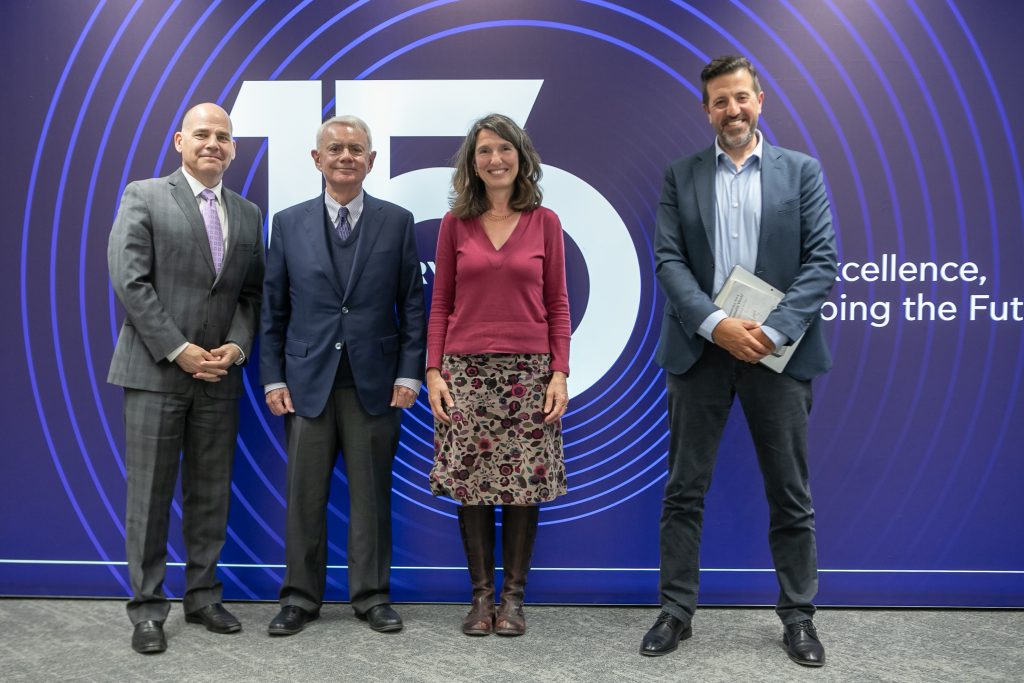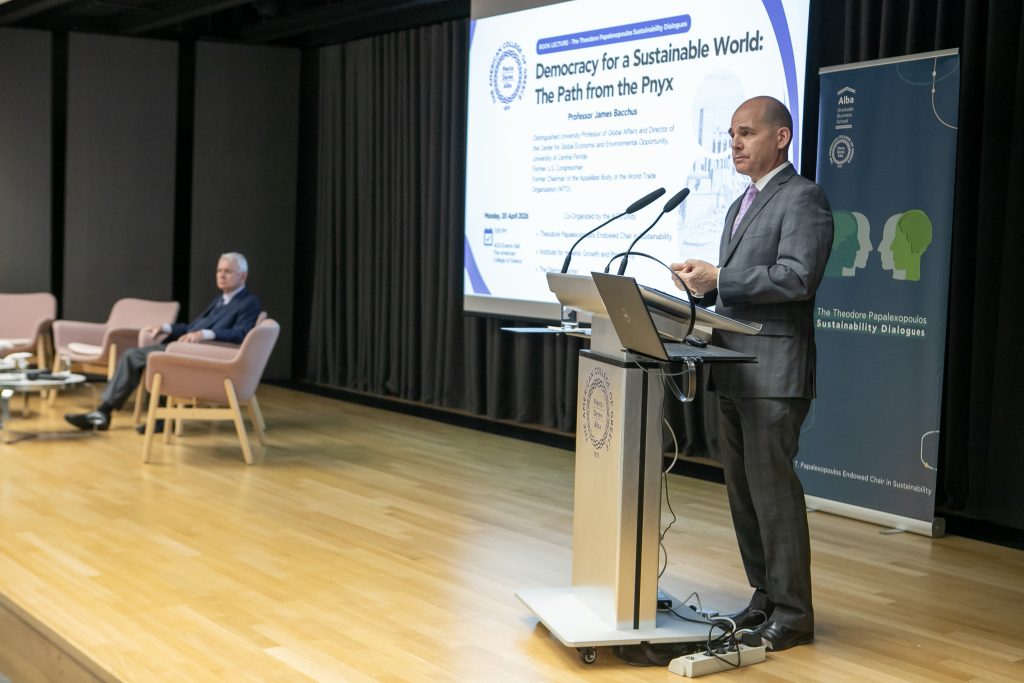
The American College of Greece welcomed Professor James Bacchus to the ACG Events Hall on April 20, 2026, for a lecture and discussion on the relationship between democratic governance and global sustainability. The event was co-organized by the Theodore Papalexopoulos Sustainability Dialogues, the Institute for Hellenic Growth and Prosperity, and The Demos Center.
Part of the Theodore Papalexopoulos Sustainability Dialogues—an Alba Graduate Business School initiative that promotes interdisciplinary engagement on critical sustainability challenges—the event brought together members of the ACG community and the wider public for an evening of reflection and dialogue.
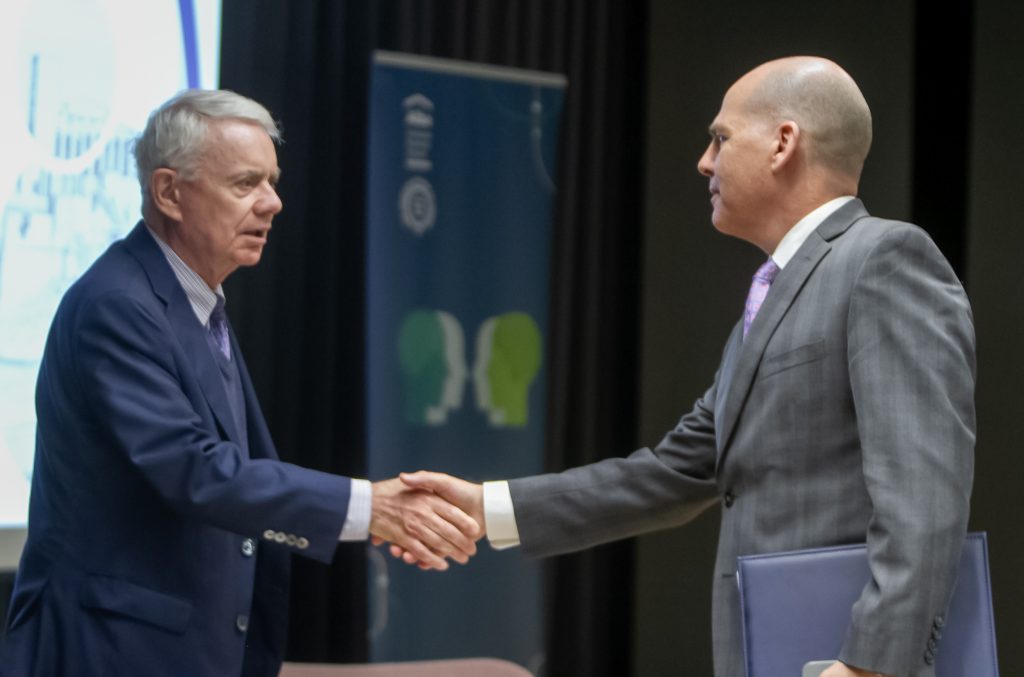
The program opened with welcome remarks by ACG President Dr. Edward Wingenbach, who highlighted two major global trends: the rise of authoritarianism and the growing gap in achieving sustainability goals. He emphasized that these challenges are closely interconnected and underscored the importance of inclusive participation as a foundation for both democratic resilience and sustainable development.
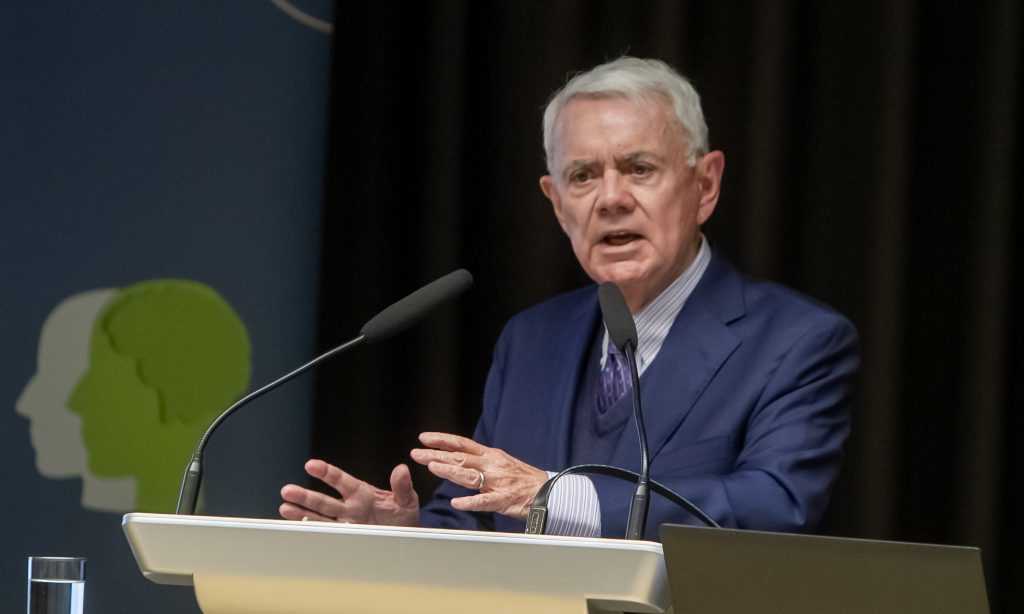
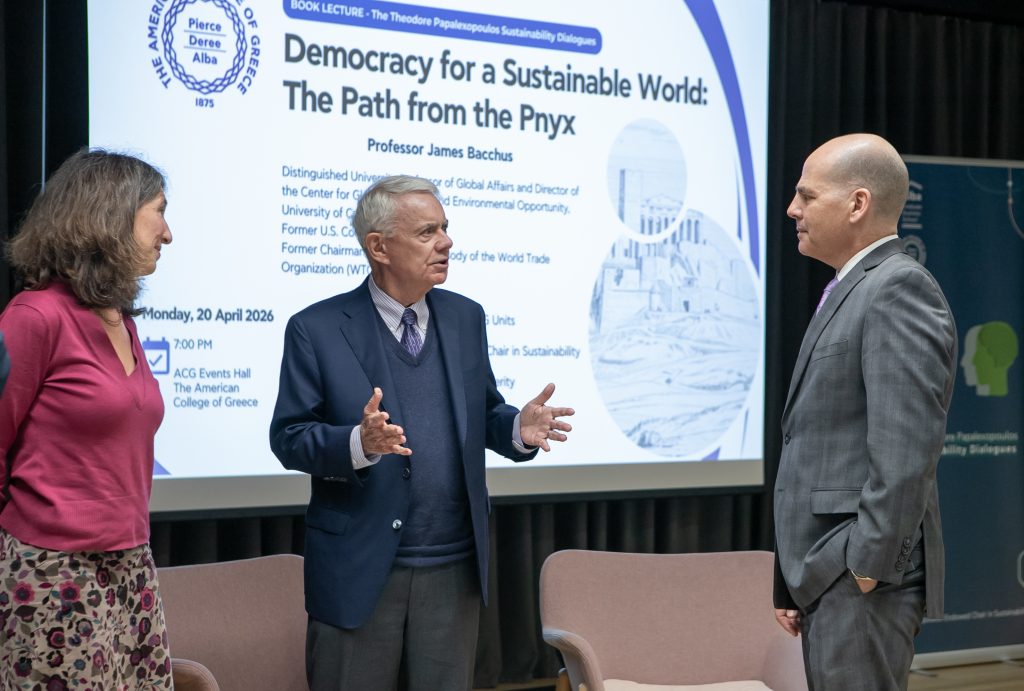
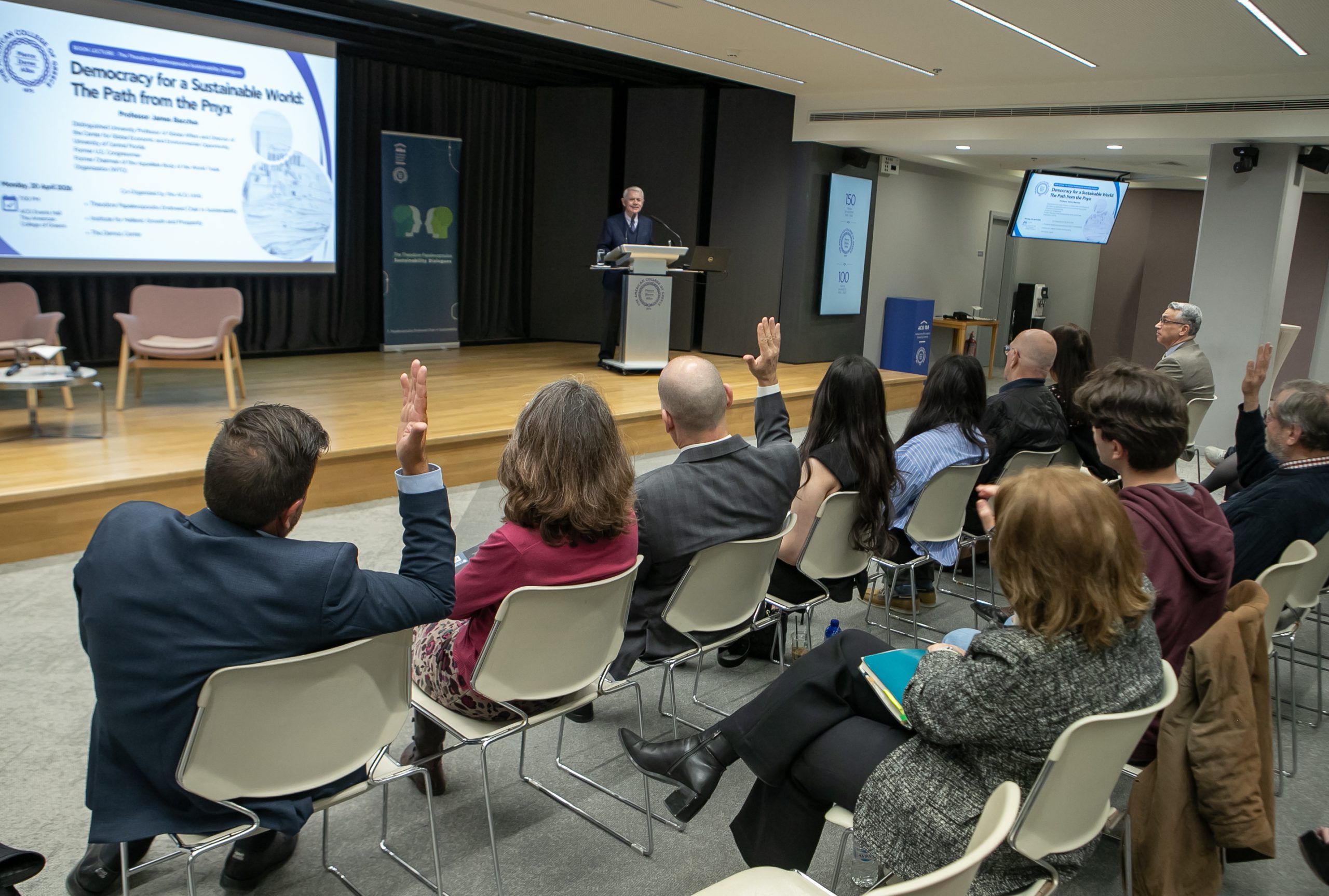
Professor Bacchus, Distinguished University Professor of Global Affairs and Director of the Center for Global Economic and Environmental Opportunity at the University of Central Florida, presented key ideas from his latest book, Democracy for a Sustainable World: The Path from the Pnyx (Cambridge University Press, 2025). In his lecture, he argued that the retreat of democracy and the failure to address global sustainability challenges stem from a shared underlying issue: declining trust in institutions, governments, and public leadership.
Drawing on both historical and contemporary examples, Bacchus emphasized that effective solutions require rethinking how democratic systems function. He highlighted the importance of citizen participation in public decision-making and proposed complementing representative democracy with participatory mechanisms such as sortition—the random selection of citizens—to strengthen accountability and restore public trust. He also stressed the need to incorporate long-term perspectives, including the interests of future generations, into governance processes.
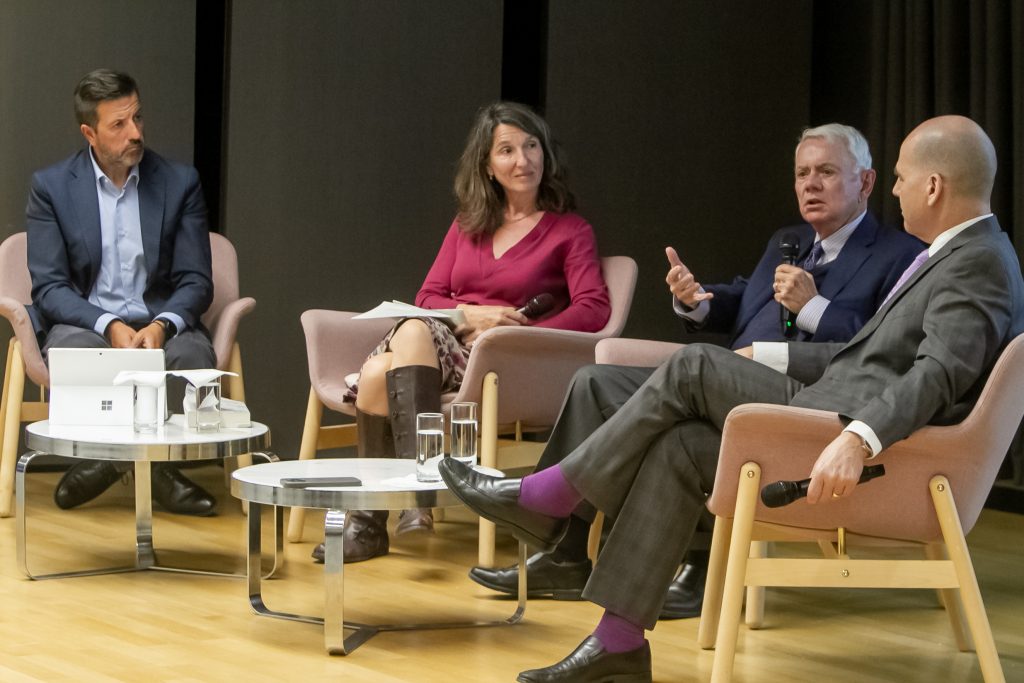
The lecture was followed by a panel discussion moderated by Professor Pavlos Vlachos, featuring Dr. Wingenbach, Professor Bacchus, and Associate Professor Effie Fokas. The discussion focused on the conditions necessary for meaningful civic participation, including the role of education, institutional design, and social trust.
Panelists noted that participation requires both opportunity and preparation. Liberal education was highlighted as a key factor in equipping individuals with the critical thinking skills and civic awareness needed to engage effectively in democratic processes. The conversation also addressed the challenges posed by polarization and misinformation, as well as the importance of fostering dialogue across different perspectives.
The role of deliberation emerged as a central theme, with particular emphasis on the value of face-to-face engagement in building trust and enabling constructive exchange. Participants discussed how creating spaces for inclusive and informed deliberation can strengthen democratic institutions and support better decision-making outcomes.
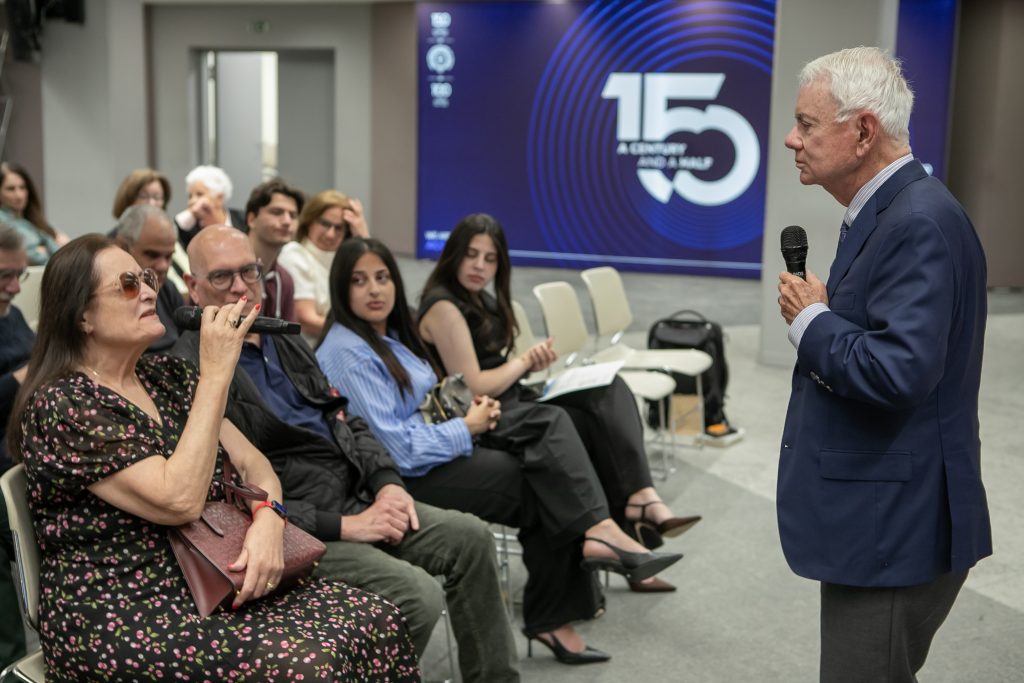
The event concluded with an open Q&A session, during which audience members engaged with the speakers on questions of representation, inclusion, and the practical implementation of participatory models. A reception followed, providing further opportunities for discussion and exchange.
Held in Athens, in close proximity to the historic Pnyx—the site of the earliest democratic assemblies—the event highlighted the continued relevance of democratic principles first developed in antiquity. It also reinforced ACG’s commitment to fostering dialogue on global challenges and to promoting active, informed citizenship.