
April
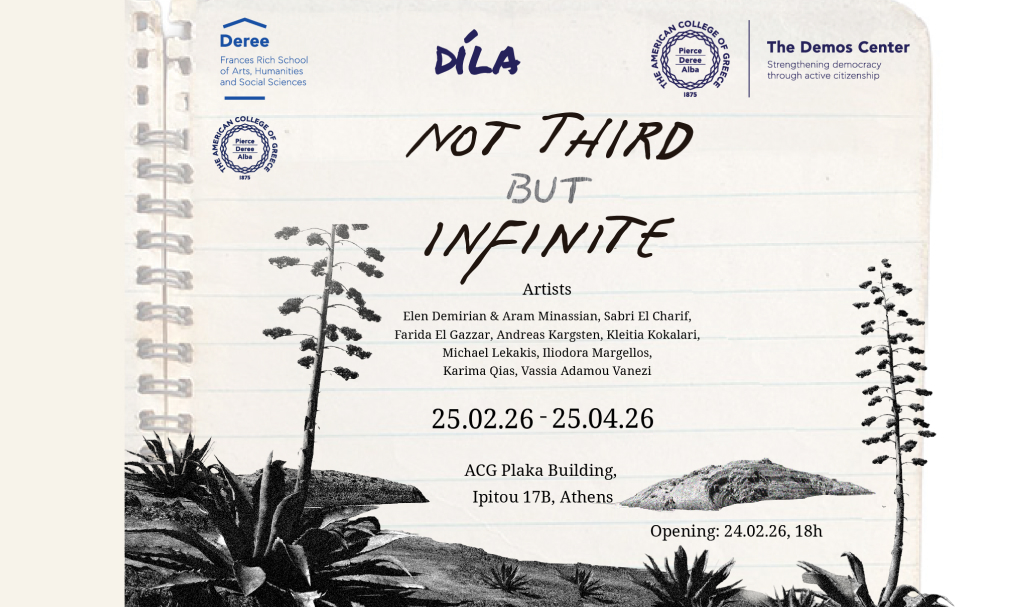
202624Feb(Feb 24)18:0025Apr(Apr 25)16:00Not Third but Infinite(February 24) 18:00 - (April 25) 16:00
Event Details
Opening: Tuesday, February 24, 2026 | 18:00-21:00 When: February 25-April 25, 2026 Opening hours: Wednesday-Friday: 15:00-19:00 & Saturday: 12:00-16:00 Closed between: April 4-19 for the Easter break Where: ACG Plaka Building,
Event Details
Opening: Tuesday, February 24, 2026 | 18:00-21:00
When: February 25-April 25, 2026
Opening hours: Wednesday-Friday: 15:00-19:00 & Saturday: 12:00-16:00
Closed between: April 4-19 for the Easter break
Where: ACG Plaka Building, 17 Ipitou St, Plaka, Athens
Curated by
ACG Art collection in collaboration with Díla
Co-organized by:
Díla
Frances Rich School of Arts, Humanities and Social Sciences, Deree – The American College of Greece
The Demos Center of The American College of Greece
About the exhibition
A new group exhibition brings together artists from diverse cross-cultural backgrounds to explore ideas of dislocation and possibility, alongside expressions of hybridity in relation to place, belonging, and selfhood.
Not Third but Infinite takes its title and conceptual framework from critical theorist Homi K. Bhabha’s notion of the “Third Space,” expanding his idea of a hybrid, imagined zone between cultures into a vision of infinite re-creation. This expansion evokes the psychological potency of utopia—a state defined by perpetual openness and possibility. Notably, the exhibition includes previously unexhibited notebooks and ephemera from the personal archive of the distinguished Greek-American artist Michael Lekakis (1907–1987). Lekakis’s work has been shown at the Metropolitan Museum of Art, MoMA, and the Guggenheim, and is held in the permanent collection of the National Gallery of Greece.
Featuring both established and posthumous artists alongside those at earlier stages of their careers, the exhibition presents poetry, painting, embroidery, works on paper, archival ephemera, and immersive installations. It collectively reflects on what it means not only to leave one’s roots behind, but also to continuously renegotiate versions of the self. These recalibrated identities are often constructed from visual fragments, memories, and sensory impressions tied to specific landscapes and physical touchpoints, which reassemble in unfamiliar yet generative ways. Greek-Egyptian painter Farida El Gazzar, continuing her evolving series of miniature paintings depicting city life, architecture, and foliage, presents scenes drawn from the urban landscapes of Athens and Alexandria, framed within kitsch decorative borders. Greek-Cypriot artist Vassia Adamou Vanezi, who describes her practice as involving “poetic gestures” and “visual poetry or concrete poetry,” engages with the contested terrain of her Cypriot homeland. Through botanicals mounted on handmade paper and layers of typed text rendered illegible through repetition, she enacts processes of confusion, re-creation, and re-meaning.
Of Korean-American origin and raised between Switzerland and Greece, multidisciplinary artist Iliodora Margellos brings her meditative stitch-based practice to her series Securities, presenting embroidered aphorisms such as A Star Is Brighter in the Clear Sky and The Sun Will Always Rise as gestures of reassurance for the untethered self. She also presents two lesser-known installations: a floor-based crochet and mirror sculpture of droplets and puddles, titled Long Quiet River—named after Étienne Chatiliez’s French comedy film “La Vie est un Long Fleuve Tranquille”—and a delicate handwoven mobile, Comforts (Very Knotty) IV, anchored by a textile knot that gestures toward entanglement and the quiet inner harmony one learns to cultivate within the layered complexities of familial identity. Kleitia Kokalari, born in Albania and raised in Athens, contributes paintings of uncanny landscapes suggestive of the subconscious, featuring border waters and a cave-like portal that appears to lead elsewhere. Zigzagging, geometrically carved sculptures by Swedish-born, Athens-based artist Andreas Kargsten punctuate corners and transitional spaces, marking thresholds between the exhibition’s rooms and corridors
Two contributions come from artists associated with Díla, a community offering mentorship to young refugee women pursuing work in the arts, which co-produced Not Third but Infinite. Upon entering the exhibition, visitors encounter a large-scale painting by Elen Demirian, a young Armenian artist currently studying Visual Arts at Deree. Her striking work 499, co-authored with her partner Aram Minassian—also of Armenian origin and now based in France—is densely layered with references to shared cultural memory, including excerpts from prayers, folk songs, and privately coded numerological symbols, together forming an intimate “third space” on the canvas. Further along the corridor, in a room of its own, visitors encounter Chink of Light, a poetry installation by Iran-born writer of Tajik origin Karima Qias, now based in Brussels. Previously installed at Pikionis’ pavilion on Philopappou Hill, the work features calligraphed pages from her handmade book lining the walls, accompanied by a video portrait and a Persian-language poetry audio track.
Text and lyrical language are among the exhibition’s defining elements. Lettering and literary forms appear across media—in collaborative painting, poetry installations, embroidery on paper and cloth, and most prominently in the poems, reflections, and jottings found in Lekakis’s notebooks. Spiritual references to the sky and the stars, with their inherently transnational and borderless qualities, recur throughout the exhibition. In one notebook poem, Lekakis writes:
“What happens to the stars at night?
They fly to Egypt
To crash at the feet of Ra
They pile so high
They slip over the ends of the earth.”
Many of the works seek either to zoom out from the earthly plane in search of broader perspective, or to capture fleeting moments as textures—through words, materials, and gestures—rendering experience tangible even as it slips away. In doing so, they register and commemorate earthly details as both anchors of belonging and points of departure. Despite their diversity of media and individual artistic languages, the works in Not Third but Infinite share an acute awareness of ephemerality and impermanence. Distributed across the ground-floor rooms of the beautifully preserved neoclassical villa of The American College of Greece (ACG) on Ipitou Street, the exhibition unfolds as a collective meditation on dislocation as both rupture and reconstitution. Particularly notable are the archival materials by Lekakis displayed in the main room: personal correspondence, photographs, and notebooks drawn from an archive held by the ACG Art Collection. Presented in traditional library display cases, these informal pages offer intimate insights into the New York–born artist’s life and imaginative world through his distinctive and evocative poetic voice.
Also of special note is a haunting basement installation by Sabri El Charif, a recent graduate of Deree’s Visual Arts Program and a young artist of Egyptian-Levantine origin. His floor-based work Under This Sky pays tribute to the tragedy of the ongoing genocide in Palestine, addressing in particular the mass graves in Gaza as a violent attempt to sever a people from their homeland.
Not Third but Infinite is co-organized by Díla, The Frances Rich School of Arts, Humanities and Social Sciences, The Demos Center of The American College of Greece. As a collaborative endeavor, the exhibition reflects the School’s commitment to offer a wide range of artistic activities and promote its students and graduates, The Demos Center’s mission to foster a sense of active citizenship—particularly among younger generations—as well as Díla’s dedication to supporting young refugee women on creative career paths.
For further clarifications, please contact [email protected]
Participating artists: Elen Demirian & Aram Minassian, Sabri El Charif, Farida El Gazzar, Andreas Kargsten, Kleitia Kokalari, Michael Lekakis, Iliodora Margellos, Karima Qias, Vassia Adamou Vanezi
Curated by: Ioanna Papapavlou and Díla
Exhibition production: Ana S. González Rueda, Katerina Milesi
Graphic Design: Elen Demirian
Gallery texts: Eliana Klathis, Katerina Merkouri, Katerina Milesi, Eva Ntampanli
Special thanks to Dean Helena Maragou, Niki Kladakis, and Dr. Mary Cardaras.
Thanks to Niky Theodorou for logistical assistance, Virna Vrettou, George Papastogiannoudis and Nikolaos Fronimos for the Marketing and PR of the exhibition, Michalis Orontis and the security team, George Kyrodimos, John Fetalidis, Victor Zafeiropoulos, as well as Haris Gialelis, Christos Mantzios, Antonis Kontopoulos, Dimitris Fakinos, Stavros Theofilou, Vasilis Palaiogiannis, Manolis Sideris, Stelios Teloniatis, Giannis Gerakellis, John Poulakis, Stavros Karadimitriou, Alekos Potamianos, Giannis Kontopoulos and Takis Moschidis for the technical support.

March
202624Feb(Feb 24)18:0025Apr(Apr 25)16:00Not Third but Infinite(February 24) 18:00 - (April 25) 16:00
Event Details
Opening: Tuesday, February 24, 2026 | 18:00-21:00 When: February 25-April 25, 2026 Opening hours: Wednesday-Friday: 15:00-19:00 & Saturday: 12:00-16:00 Closed between: April 4-19 for the Easter break Where: ACG Plaka Building,
Event Details
Opening: Tuesday, February 24, 2026 | 18:00-21:00
When: February 25-April 25, 2026
Opening hours: Wednesday-Friday: 15:00-19:00 & Saturday: 12:00-16:00
Closed between: April 4-19 for the Easter break
Where: ACG Plaka Building, 17 Ipitou St, Plaka, Athens
Curated by
ACG Art collection in collaboration with Díla
Co-organized by:
Díla
Frances Rich School of Arts, Humanities and Social Sciences, Deree – The American College of Greece
The Demos Center of The American College of Greece
About the exhibition
A new group exhibition brings together artists from diverse cross-cultural backgrounds to explore ideas of dislocation and possibility, alongside expressions of hybridity in relation to place, belonging, and selfhood.
Not Third but Infinite takes its title and conceptual framework from critical theorist Homi K. Bhabha’s notion of the “Third Space,” expanding his idea of a hybrid, imagined zone between cultures into a vision of infinite re-creation. This expansion evokes the psychological potency of utopia—a state defined by perpetual openness and possibility. Notably, the exhibition includes previously unexhibited notebooks and ephemera from the personal archive of the distinguished Greek-American artist Michael Lekakis (1907–1987). Lekakis’s work has been shown at the Metropolitan Museum of Art, MoMA, and the Guggenheim, and is held in the permanent collection of the National Gallery of Greece.
Featuring both established and posthumous artists alongside those at earlier stages of their careers, the exhibition presents poetry, painting, embroidery, works on paper, archival ephemera, and immersive installations. It collectively reflects on what it means not only to leave one’s roots behind, but also to continuously renegotiate versions of the self. These recalibrated identities are often constructed from visual fragments, memories, and sensory impressions tied to specific landscapes and physical touchpoints, which reassemble in unfamiliar yet generative ways. Greek-Egyptian painter Farida El Gazzar, continuing her evolving series of miniature paintings depicting city life, architecture, and foliage, presents scenes drawn from the urban landscapes of Athens and Alexandria, framed within kitsch decorative borders. Greek-Cypriot artist Vassia Adamou Vanezi, who describes her practice as involving “poetic gestures” and “visual poetry or concrete poetry,” engages with the contested terrain of her Cypriot homeland. Through botanicals mounted on handmade paper and layers of typed text rendered illegible through repetition, she enacts processes of confusion, re-creation, and re-meaning.
Of Korean-American origin and raised between Switzerland and Greece, multidisciplinary artist Iliodora Margellos brings her meditative stitch-based practice to her series Securities, presenting embroidered aphorisms such as A Star Is Brighter in the Clear Sky and The Sun Will Always Rise as gestures of reassurance for the untethered self. She also presents two lesser-known installations: a floor-based crochet and mirror sculpture of droplets and puddles, titled Long Quiet River—named after Étienne Chatiliez’s French comedy film “La Vie est un Long Fleuve Tranquille”—and a delicate handwoven mobile, Comforts (Very Knotty) IV, anchored by a textile knot that gestures toward entanglement and the quiet inner harmony one learns to cultivate within the layered complexities of familial identity. Kleitia Kokalari, born in Albania and raised in Athens, contributes paintings of uncanny landscapes suggestive of the subconscious, featuring border waters and a cave-like portal that appears to lead elsewhere. Zigzagging, geometrically carved sculptures by Swedish-born, Athens-based artist Andreas Kargsten punctuate corners and transitional spaces, marking thresholds between the exhibition’s rooms and corridors
Two contributions come from artists associated with Díla, a community offering mentorship to young refugee women pursuing work in the arts, which co-produced Not Third but Infinite. Upon entering the exhibition, visitors encounter a large-scale painting by Elen Demirian, a young Armenian artist currently studying Visual Arts at Deree. Her striking work 499, co-authored with her partner Aram Minassian—also of Armenian origin and now based in France—is densely layered with references to shared cultural memory, including excerpts from prayers, folk songs, and privately coded numerological symbols, together forming an intimate “third space” on the canvas. Further along the corridor, in a room of its own, visitors encounter Chink of Light, a poetry installation by Iran-born writer of Tajik origin Karima Qias, now based in Brussels. Previously installed at Pikionis’ pavilion on Philopappou Hill, the work features calligraphed pages from her handmade book lining the walls, accompanied by a video portrait and a Persian-language poetry audio track.
Text and lyrical language are among the exhibition’s defining elements. Lettering and literary forms appear across media—in collaborative painting, poetry installations, embroidery on paper and cloth, and most prominently in the poems, reflections, and jottings found in Lekakis’s notebooks. Spiritual references to the sky and the stars, with their inherently transnational and borderless qualities, recur throughout the exhibition. In one notebook poem, Lekakis writes:
“What happens to the stars at night?
They fly to Egypt
To crash at the feet of Ra
They pile so high
They slip over the ends of the earth.”
Many of the works seek either to zoom out from the earthly plane in search of broader perspective, or to capture fleeting moments as textures—through words, materials, and gestures—rendering experience tangible even as it slips away. In doing so, they register and commemorate earthly details as both anchors of belonging and points of departure. Despite their diversity of media and individual artistic languages, the works in Not Third but Infinite share an acute awareness of ephemerality and impermanence. Distributed across the ground-floor rooms of the beautifully preserved neoclassical villa of The American College of Greece (ACG) on Ipitou Street, the exhibition unfolds as a collective meditation on dislocation as both rupture and reconstitution. Particularly notable are the archival materials by Lekakis displayed in the main room: personal correspondence, photographs, and notebooks drawn from an archive held by the ACG Art Collection. Presented in traditional library display cases, these informal pages offer intimate insights into the New York–born artist’s life and imaginative world through his distinctive and evocative poetic voice.
Also of special note is a haunting basement installation by Sabri El Charif, a recent graduate of Deree’s Visual Arts Program and a young artist of Egyptian-Levantine origin. His floor-based work Under This Sky pays tribute to the tragedy of the ongoing genocide in Palestine, addressing in particular the mass graves in Gaza as a violent attempt to sever a people from their homeland.
Not Third but Infinite is co-organized by Díla, The Frances Rich School of Arts, Humanities and Social Sciences, The Demos Center of The American College of Greece. As a collaborative endeavor, the exhibition reflects the School’s commitment to offer a wide range of artistic activities and promote its students and graduates, The Demos Center’s mission to foster a sense of active citizenship—particularly among younger generations—as well as Díla’s dedication to supporting young refugee women on creative career paths.
For further clarifications, please contact [email protected]
Participating artists: Elen Demirian & Aram Minassian, Sabri El Charif, Farida El Gazzar, Andreas Kargsten, Kleitia Kokalari, Michael Lekakis, Iliodora Margellos, Karima Qias, Vassia Adamou Vanezi
Curated by: Ioanna Papapavlou and Díla
Exhibition production: Ana S. González Rueda, Katerina Milesi
Graphic Design: Elen Demirian
Gallery texts: Eliana Klathis, Katerina Merkouri, Katerina Milesi, Eva Ntampanli
Special thanks to Dean Helena Maragou, Niki Kladakis, and Dr. Mary Cardaras.
Thanks to Niky Theodorou for logistical assistance, Virna Vrettou, George Papastogiannoudis and Nikolaos Fronimos for the Marketing and PR of the exhibition, Michalis Orontis and the security team, George Kyrodimos, John Fetalidis, Victor Zafeiropoulos, as well as Haris Gialelis, Christos Mantzios, Antonis Kontopoulos, Dimitris Fakinos, Stavros Theofilou, Vasilis Palaiogiannis, Manolis Sideris, Stelios Teloniatis, Giannis Gerakellis, John Poulakis, Stavros Karadimitriou, Alekos Potamianos, Giannis Kontopoulos and Takis Moschidis for the technical support.
February
202624Feb(Feb 24)18:0025Apr(Apr 25)16:00Not Third but Infinite18:00 - (April 25) 16:00
Event Details
Opening: Tuesday, February 24, 2026 | 18:00-21:00 When: February 25-April 25, 2026 Opening hours: Wednesday-Friday: 15:00-19:00 & Saturday: 12:00-16:00 Closed between: April 4-19 for the Easter break Where: ACG Plaka Building,
Event Details
Opening: Tuesday, February 24, 2026 | 18:00-21:00
When: February 25-April 25, 2026
Opening hours: Wednesday-Friday: 15:00-19:00 & Saturday: 12:00-16:00
Closed between: April 4-19 for the Easter break
Where: ACG Plaka Building, 17 Ipitou St, Plaka, Athens
Curated by
ACG Art collection in collaboration with Díla
Co-organized by:
Díla
Frances Rich School of Arts, Humanities and Social Sciences, Deree – The American College of Greece
The Demos Center of The American College of Greece
About the exhibition
A new group exhibition brings together artists from diverse cross-cultural backgrounds to explore ideas of dislocation and possibility, alongside expressions of hybridity in relation to place, belonging, and selfhood.
Not Third but Infinite takes its title and conceptual framework from critical theorist Homi K. Bhabha’s notion of the “Third Space,” expanding his idea of a hybrid, imagined zone between cultures into a vision of infinite re-creation. This expansion evokes the psychological potency of utopia—a state defined by perpetual openness and possibility. Notably, the exhibition includes previously unexhibited notebooks and ephemera from the personal archive of the distinguished Greek-American artist Michael Lekakis (1907–1987). Lekakis’s work has been shown at the Metropolitan Museum of Art, MoMA, and the Guggenheim, and is held in the permanent collection of the National Gallery of Greece.
Featuring both established and posthumous artists alongside those at earlier stages of their careers, the exhibition presents poetry, painting, embroidery, works on paper, archival ephemera, and immersive installations. It collectively reflects on what it means not only to leave one’s roots behind, but also to continuously renegotiate versions of the self. These recalibrated identities are often constructed from visual fragments, memories, and sensory impressions tied to specific landscapes and physical touchpoints, which reassemble in unfamiliar yet generative ways. Greek-Egyptian painter Farida El Gazzar, continuing her evolving series of miniature paintings depicting city life, architecture, and foliage, presents scenes drawn from the urban landscapes of Athens and Alexandria, framed within kitsch decorative borders. Greek-Cypriot artist Vassia Adamou Vanezi, who describes her practice as involving “poetic gestures” and “visual poetry or concrete poetry,” engages with the contested terrain of her Cypriot homeland. Through botanicals mounted on handmade paper and layers of typed text rendered illegible through repetition, she enacts processes of confusion, re-creation, and re-meaning.
Of Korean-American origin and raised between Switzerland and Greece, multidisciplinary artist Iliodora Margellos brings her meditative stitch-based practice to her series Securities, presenting embroidered aphorisms such as A Star Is Brighter in the Clear Sky and The Sun Will Always Rise as gestures of reassurance for the untethered self. She also presents two lesser-known installations: a floor-based crochet and mirror sculpture of droplets and puddles, titled Long Quiet River—named after Étienne Chatiliez’s French comedy film “La Vie est un Long Fleuve Tranquille”—and a delicate handwoven mobile, Comforts (Very Knotty) IV, anchored by a textile knot that gestures toward entanglement and the quiet inner harmony one learns to cultivate within the layered complexities of familial identity. Kleitia Kokalari, born in Albania and raised in Athens, contributes paintings of uncanny landscapes suggestive of the subconscious, featuring border waters and a cave-like portal that appears to lead elsewhere. Zigzagging, geometrically carved sculptures by Swedish-born, Athens-based artist Andreas Kargsten punctuate corners and transitional spaces, marking thresholds between the exhibition’s rooms and corridors
Two contributions come from artists associated with Díla, a community offering mentorship to young refugee women pursuing work in the arts, which co-produced Not Third but Infinite. Upon entering the exhibition, visitors encounter a large-scale painting by Elen Demirian, a young Armenian artist currently studying Visual Arts at Deree. Her striking work 499, co-authored with her partner Aram Minassian—also of Armenian origin and now based in France—is densely layered with references to shared cultural memory, including excerpts from prayers, folk songs, and privately coded numerological symbols, together forming an intimate “third space” on the canvas. Further along the corridor, in a room of its own, visitors encounter Chink of Light, a poetry installation by Iran-born writer of Tajik origin Karima Qias, now based in Brussels. Previously installed at Pikionis’ pavilion on Philopappou Hill, the work features calligraphed pages from her handmade book lining the walls, accompanied by a video portrait and a Persian-language poetry audio track.
Text and lyrical language are among the exhibition’s defining elements. Lettering and literary forms appear across media—in collaborative painting, poetry installations, embroidery on paper and cloth, and most prominently in the poems, reflections, and jottings found in Lekakis’s notebooks. Spiritual references to the sky and the stars, with their inherently transnational and borderless qualities, recur throughout the exhibition. In one notebook poem, Lekakis writes:
“What happens to the stars at night?
They fly to Egypt
To crash at the feet of Ra
They pile so high
They slip over the ends of the earth.”
Many of the works seek either to zoom out from the earthly plane in search of broader perspective, or to capture fleeting moments as textures—through words, materials, and gestures—rendering experience tangible even as it slips away. In doing so, they register and commemorate earthly details as both anchors of belonging and points of departure. Despite their diversity of media and individual artistic languages, the works in Not Third but Infinite share an acute awareness of ephemerality and impermanence. Distributed across the ground-floor rooms of the beautifully preserved neoclassical villa of The American College of Greece (ACG) on Ipitou Street, the exhibition unfolds as a collective meditation on dislocation as both rupture and reconstitution. Particularly notable are the archival materials by Lekakis displayed in the main room: personal correspondence, photographs, and notebooks drawn from an archive held by the ACG Art Collection. Presented in traditional library display cases, these informal pages offer intimate insights into the New York–born artist’s life and imaginative world through his distinctive and evocative poetic voice.
Also of special note is a haunting basement installation by Sabri El Charif, a recent graduate of Deree’s Visual Arts Program and a young artist of Egyptian-Levantine origin. His floor-based work Under This Sky pays tribute to the tragedy of the ongoing genocide in Palestine, addressing in particular the mass graves in Gaza as a violent attempt to sever a people from their homeland.
Not Third but Infinite is co-organized by Díla, The Frances Rich School of Arts, Humanities and Social Sciences, The Demos Center of The American College of Greece. As a collaborative endeavor, the exhibition reflects the School’s commitment to offer a wide range of artistic activities and promote its students and graduates, The Demos Center’s mission to foster a sense of active citizenship—particularly among younger generations—as well as Díla’s dedication to supporting young refugee women on creative career paths.
For further clarifications, please contact [email protected]
Participating artists: Elen Demirian & Aram Minassian, Sabri El Charif, Farida El Gazzar, Andreas Kargsten, Kleitia Kokalari, Michael Lekakis, Iliodora Margellos, Karima Qias, Vassia Adamou Vanezi
Curated by: Ioanna Papapavlou and Díla
Exhibition production: Ana S. González Rueda, Katerina Milesi
Graphic Design: Elen Demirian
Gallery texts: Eliana Klathis, Katerina Merkouri, Katerina Milesi, Eva Ntampanli
Special thanks to Dean Helena Maragou, Niki Kladakis, and Dr. Mary Cardaras.
Thanks to Niky Theodorou for logistical assistance, Virna Vrettou, George Papastogiannoudis and Nikolaos Fronimos for the Marketing and PR of the exhibition, Michalis Orontis and the security team, George Kyrodimos, John Fetalidis, Victor Zafeiropoulos, as well as Haris Gialelis, Christos Mantzios, Antonis Kontopoulos, Dimitris Fakinos, Stavros Theofilou, Vasilis Palaiogiannis, Manolis Sideris, Stelios Teloniatis, Giannis Gerakellis, John Poulakis, Stavros Karadimitriou, Alekos Potamianos, Giannis Kontopoulos and Takis Moschidis for the technical support.
202613Feb13:3015:30The Heart in Music and Medicine13:30 - 15:30
Event Details
The Heart in Music and Medicine When: Friday, February 13, 2026 | 13:30 – 15:30 Where: ACG Events Hall, DC, Ag. Paraskevi Campus Organized by: Dr Tatiana Papageorgiou, Associate Professor, Deree Music Department,
Event Details
The Heart in Music and Medicine
When:
Friday, February 13, 2026 | 13:30 – 15:30
Where:
ACG Events Hall, DC, Ag. Paraskevi Campus
Organized by:
Dr Tatiana Papageorgiou, Associate Professor, Deree Music Department, FRSAHSS,
The American College of Greece
Supported by:
The Frances Riches School of Arts, Humanities and Social Sciences,
The American College of Greece
In collaboration with:
The Biomedical Sciences Program, Department of Science and Mathematics, and the Department of Psychology – School of Sciences and Technology, and the ACG Health & Wellness Center
About the event
On the occasion of the World Congenital Heart Defect Awareness Day, which symbolically coincides with Valentine’s Day, ACG will host a special interdisciplinary event of lectures and live music performances, titled “The Heart in Music and Medicine”. The event, which is organized by Associate Professor of Music Tatiana Papageorgiou and supported by the Frances Rich School of Arts, Humanities, and Social Sciences, features distinguished guest speakers from different disciplines to celebrate the enduring relationship between music, medicine, psychology and the biomedical sciences.
We are happy to announce that Minister of Health Adonis Georgiadis will be able to attend in order to share his insights on the topic with Deree students, faculty and guests.
Interventional cardiologist, Dr. Spyros Papaioannou (Director of Cardiology Clinic at the Athens Naval Hospital, Director of the Hellenic Society of Athletic Cardiology, and member of the European and American Cardiology Societies), will speak on congenital heart defects and sudden cardiac death in young people and athletes, stressing the significance of prevention and proper treatment.
Dr. Paraskevi Papadopoulou, ACG Professor of Biomedical Sciences & Environmental Studies, a senior collaborator of the Global Burden of Disease (GBD) network, will present important findings from the recent GBD cardiovascular study she has participated in as co-author, ‘Global, Regional, and National Burden of Cardiovascular Diseases and Risk Factors in 204 Countries and Territories’ (1990-2023), published by the Journal of the American College of Cardiology.
Dr. Ion Beratis, ACG Associate Professor of Psychology and Scientific Associate of the First Department of Neurology at ‘Aeginitio’ University Hospital, a clinical center of excellence for neurological diseases, will speak on the relationship between music and mental health and the bidirectional brain-heart connection.
Dr. Tatiana Papageorgiou, ACG Associate Professor of Music and active performing musician, will share research findings about the effects of music and rhythm on heart rate, using musical examples, while referring to the development of music therapy as a formal health-care profession today.
Ms. Sophie Themelis, Executive Coordinator for Wellness at the ACG Health & Wellness Center, Pilates Instructor, and a passionate advocate for wellbeing and sustainability, dedicated to integrating eco-conscious practices into health and wellness initiatives, will share techniques of meditation with music, as a tool for improving emotional regulation and physical health.
The lectures will be interspersed with live music performances of iconic songs about the heart, presented by talented young artists from the Deree Music Program of the American College of Greece.
Join us for this unique interdisciplinary event featuring a series of insightful lectures and performances that bridge the realms of cardiology, biomedical research, psychology and music, while celebrating the heart – both as a vital organ for human life and wellbeing, and as a universal symbol of emotion and connection.
A Certificate of Attendance will be issued to student participants in recognition of their participation and engagement in this extracurricular event.

Speakers
Dr. Spyros Papaioannou, MD, PhD, FESC, FSCAI
Interventional Cardiologist, Director at the Athens Naval Hospital’s 2nd Cardiology Clinic, Director of the Hellenic Society of Athletic Cardiology.
Dr. Spyros Papaioannou is recognized as one of the leading cardiologists in the country. He has been Director of the Athens Naval Hospital’s 2nd Cardiology Clinic since 2017 and has served in all key positions within the healthcare sector of the Hellenic Navy. Dr Papaioannou has over 30 years of experience in clinical, consultative and interventional cardiology, having built a high reputation for the diagnosis and treatment of cardiovascular disease. He also specializes in athletic cardiology, the risk factors and prevention of sudden cardiac death in young people and athletes, currently also serving as Director of the Hellenic Society of Athletic Cardiology. Dr Papaioannou graduated from the Military Medical School of Thessaloniki and continued his training at the Mayo Clinic in Jacksonville, Florida, USA. He completed his specialty at the Onassis Cardiac Surgery Center, and in 2003, he earned a Ph.D. from the Aristotle University of Thessaloniki (AUTH). He specialized in interventional cardiology at Walsgrave Hospital in the United Kingdom and has, since then, performed over 1,000 invasive procedures. Dr Papaioannou has participated as a chairman and speaker in over 550 cardiology conferences in Greece and abroad and has published 80 scientific papers in national and international journals. In April 2022, he was appointed Professor of Cardiology at the European University of Cyprus. He is a member of both the European and American Cardiology Societies.
Dr. Paraskevi Papadopoulou, PhD
Professor of Biomedical Sciences & Environmental Studies at Deree – The American College of Greece
Dr. Paraskevi Papadopoulou is Professor in the Biomedical Sciences & Environmental Studies programs at Deree-The American College of Greece. She holds a BSc in Biology from the University of California, Los Angeles, and BSc and PhD in Biology from the National and Kapodistrian University of Athens. Currently she is Strategic Research Advisor at the Digital Health Literacy and Policy Hub, an initiative of the Nanopoulos Foundation, Inc. Her expertise spans cell biology, structural biology, molecular biophysics and bioinformatics, digital health, STEM education, and sustainability. She has extensive experience in institutional leadership for over fifteen years, recently having served as Head of the Department of Science and Mathematics, and Program Director of the Biomedical Sciences Program at Deree (2020-2023), while coordinating curriculum development and innovation initiatives. She is also the Founder of the Biomedical Science Research (BMSR) Team and has served as Team Leader @ Research, Technology, & Innovation Network (RTIN) from Sep. 2021 to Aug. 2024. Prof. Papadopoulou is a Senior Collaborator of the Global Burden of Disease (GBD) Network and Associate Editor in Frontiers in Digital Health | Personalized Medicine. She has participated as co-PI of the ACGRC partner in the Erasmus+ project SDG4U and has authored over 70 scientific publications and co-edited multiple international volumes on AI, health, digital health and education.

Dr. Ion Beratis, PhD
Associate Professor, Department of Psychology, Deree – The American College of Greece
Dr. Ion Beratis is Associate Professor of Psychology at Deree-The American College of Greece, and Scientific Associate of the First Department of Neurology at the ‘Eginition’ University Hospital, a clinical center of excellence for neurological diseases and the largest one in the country. He is also External Supervisor of the Alzheimer Centre of the ‘Nestor’ Psychogeriatric Association. Dr. Beratis’s academic background includes a Psychology Degree from the Department of Psychology of the National and Kapodistrian University of Athens (Excellent), a Master of Science in the field of Neuropsychology from the University of Edinburgh (Excellent) and a PhD degree from the 1st Department of Psychiatry of the Medical School of the National and Kapodistrian University of Athens (Excellent). Also, he has completed his clinical training in cognitive psychotherapy by the Hellenic Association of Cognitive Psychotherapies. Dr. Beratis has conducted research in the Departments of Psychiatry and Neurology of the National and Kapodistrian University of Athens, the Department of Psychiatry of the University of Patras, the University Mental Health Research Institute of Athens and the Department of Neuroscience of the University of Edinburgh, and the Department of Psychology of the American College of Greece. His research work has been published in international peer reviewed journals and has been presented in Hellenic and International Scientific Congresses. In addition, Dr Beratis has received several scientific awards and is serving as reviewer for peer-reviewed international journals in the field of Neuropsychology.
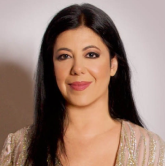
Dr. Tatiana Papageorgiou, PhD
Associate Professor, Department of Music, Deree – The American College of Greece
Dr. Tatiana Papageorgiou is a concert pianist, music theorist, orchestrator and scholar. She has maintained an active performing career with appearances on six continents and collaborations as piano soloist with prestigious orchestras including the London Philharmonic, Beijing Symphony, Moscow New Opera Symphony, Warsaw Opera Symphony, the Greek National Radio Symphony, the Athens and the Thessaloniki State Symphony Orchestras. As orchestrator she has worked in a wide range of styles from Bach and Chopin to modern Greek music. Renowned orchestras, including the Moscow Chamber Orchestra and the Sinfonia Varsovia, have performed her orchestrations, and her publishers include Schott Music in Mainz, Germany. Dr. Papageorgiou is a graduate of the Royal College and the Royal Academy of Music in London, and a recipient of prestigious awards as concert pianist. She also holds a Ph.D. in musicology from Birmingham City University, UK, having completed groundbreaking doctoral research into the piano-symphonic music of legendary Greek composer Mikis Theodorakis (1925-2021), part of which was pursued at Cornell University, New York, while a Fellow Researcher at the School of Mediterranean Studies. Recognized as one of the leading Theodorakis experts today, her research spans performance, editorial practice and scholarly writing, while her close, 23-year collaboration with the composer has resulted in the unearthing of several unpublished works for piano and orchestra, a complete discography and several world premiere performances with the composer himself on the podium. Dr Papageorgiou has been a member of the Deree Music Faculty since 1999, also serving as Coordinator of the Music Program (2000-2008), while contributing to curricular design and cultural initiatives. Her teaching and scholarly work focus on performance, music theory, cultural studies, Greek music and film music aesthetics. Her recent research explores the therapeutic function of music and creativity, as revealed in the cases of composers Frédéric Chopin, Sergei Rachmaninoff and Mikis Theodorakis.
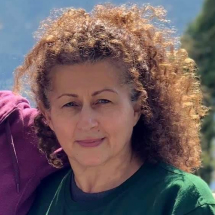
Sophie Themelis
Executive Coordinator, Wellness, Pilates Instructor, ACG Health and Wellness Center
Born and raised in Amman, Jordan. With a BA in Dance and a strong background in exercise, meditation and wellness, she has been working since 1990 at Deree as a group fitness instructor, faculty member, Recreational Sports Coordinator and finally Executive Coordinator, Wellness. Her expertise in group fitness and personal training enabled her to work in spas and sports clubs in Greece and Jordan and had a daily fitness program on Jordanian National Television. She has participated in congresses and seminars in Greece and abroad with the latest being: The Pilates Coach-Germany, The Physicalmind Institute/The Method Pilates -U.S.A, Grounding, Reiki, Biosynthesis, Pranic Healing Light- Greece. She has been a member of IDEA (The Health and Fitness Source) since 1998. Sophie speaks Arabic, English, French and Greek.
The event is free and open to the public.
For further clarifications, please contact [email protected]
January
Event Details
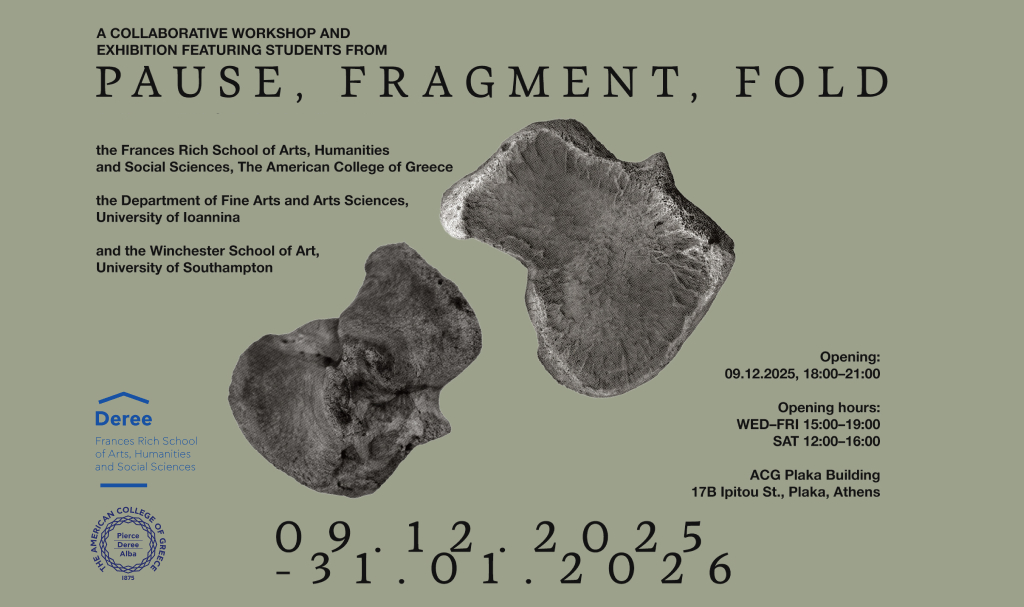
Pause, Fragment, Fold Curated by Dr. Giorgos Kontis Coordinated with Jennifer Nelson Opening: Tuesday, December 9, 2025 | 18:00 - 21:00 Exhibition duration: 10 December, 2025 - 31 January, 2026 Opening
Event Details
Pause, Fragment, Fold
Curated by Dr. Giorgos Kontis
Coordinated with Jennifer Nelson
Opening: Tuesday, December 9, 2025 | 18:00 – 21:00
Exhibition duration: 10 December, 2025 – 31 January, 2026
Opening hours: Wednesday-Friday: 15.00-19.00 Saturdays: 12.00-16.00
Closed between 22 December and 6 January
Where:
ACG Plaka Building, 17B Ipitou St, Plaka, Athens
Organized by:
The Visual Arts program at the Frances Rich School of Arts, Humanities and Social Sciences,
Deree – The American College of Greece
About the exhibition
Pause, Fragment, Fold presents the outcome of a collaborative process between students from the Frances Rich School of Arts, Humanities and Social Sciences at The American College of Greece, the Department of Fine Arts and Arts Sciences at the University of Ioannina, and the Winchester School of Art at the University of Southampton. Through a series of workshops, the students examined authorship, collective work, and dialogic artistic practice while also engaging with the ACG Art Collection. The exhibition foregrounds the fragment as a conceptual locus for rethinking form, narrative, and the conditions under which meaning emerges.
Engaging with the Kantian notion of schematism—the process through which a schema (form, shape) enables a concept to become sensible—the exhibition probes the conventional understanding that the schema follows the concept, serving not as its representation but as its vehicle. Pause, Fragment, Fold proposes an inversion of this trajectory: What if form were to precede concept? What if a schema were to arise first, not as a product of thought but as an open entity awaiting association, narrative, or conceptual articulation? Within this reframed logic, the fragment functions as a remnant or trace—seemingly empty, yet resonant with latent meaning. It is a shard of suspended stories, a part that gestures toward a possible whole without ever fully resolving into it. The fragment remains paused: incomplete but not inert, provisional yet charged with the potential to host new narratives and new conceptual formulations.
The exhibition further draws on Deleuze’s notion of the fold, positioning the fragment not as a discrete or isolated piece but as a point of continuous inflection. Here, the fold marks a moment within an ongoing development of form, where part and whole are not fixed oppositions but states that twist into and out of one another. A fold embodies both pause and movement—a holding pattern on the threshold of transformation.
Through works that test these conceptual thresholds, Pause, Fragment, Fold invites critical reflection on how meaning is produced, deferred, or reconstituted within artistic practice. By foregrounding the fragment as both vessel and rupture, the exhibition opens a space in which to reconsider the temporal and material conditions that shape creative processes today.
This exhibition is free and open to the public.
For further clarifications, please contact [email protected]
Participating artists:
Maria Adamidou, Konstantina Chatzouli, Evi Chondri, Elen Demirian, Nefeli Dimou, Maria-Louisa Dollete, Anna Giakoumakatou, Margarita Giannakopoulou, Xenia Giannoulatou, Theodoros Gkolas, Foivi Kainourgiou, Aristi Kouri, Anna Livieratou, Martha Marinou, Katerina Milesi, , Kostas Papapetros, Ioannis Sarris, Konstantina Sidera, Georgios Theodorakakos, Aggeliki Tsantila, Christina Tsaprailis, Veronica Vergou, Natalia Zara, L2 & L3 Winchester School of Art Fine Art Students (Painting, Sculpture & Printmaking), and selected works from the ACG Art Collection.
Exhibition Production:
Ana S. González Rueda, Katerina Milesi
Graphic Design:
Katerina Milesi
Visual Arts assistant:
Ioannis Sarris
Special thanks to Dean Helena Maragou, Niki Kladakis, Dr. Mary Cardaras, Ioanna Papapavlou, Dr. Christina Mamakos, and Maria Lalou.
Thanks to Niky Theodorou for logistical assistance, Maria Petrou for artwork conservation, George Papastogiannoudis and Nikolaos Fronimos for the Marketing and PR of the exhibition, Michalis Orontis and the security team, George Kyrodimos, John Fetalidis, Victor Zafeiropoulos, as well as Haris Gialelis, Christos Mantzios, Antonis Kontopoulos, Dimitris Fakinos, Stavros Theofilou, Vasilis Palaiogiannis, Manolis Sideris, Stelios Teloniatis, Giannis Gerakellis, John Poulakis, Stavros Karadimitriou, Alekos Potamianos, Giannis Kontopoulos and Takis Moschidis for the technical support.
December
Event Details
Pause, Fragment, Fold Curated by Dr. Giorgos Kontis Coordinated with Jennifer Nelson Opening: Tuesday, December 9, 2025 | 18:00 - 21:00 Exhibition duration: 10 December, 2025 - 31 January, 2026 Opening
Event Details
Pause, Fragment, Fold
Curated by Dr. Giorgos Kontis
Coordinated with Jennifer Nelson
Opening: Tuesday, December 9, 2025 | 18:00 – 21:00
Exhibition duration: 10 December, 2025 – 31 January, 2026
Opening hours: Wednesday-Friday: 15.00-19.00 Saturdays: 12.00-16.00
Closed between 22 December and 6 January
Where:
ACG Plaka Building, 17B Ipitou St, Plaka, Athens
Organized by:
The Visual Arts program at the Frances Rich School of Arts, Humanities and Social Sciences,
Deree – The American College of Greece
About the exhibition
Pause, Fragment, Fold presents the outcome of a collaborative process between students from the Frances Rich School of Arts, Humanities and Social Sciences at The American College of Greece, the Department of Fine Arts and Arts Sciences at the University of Ioannina, and the Winchester School of Art at the University of Southampton. Through a series of workshops, the students examined authorship, collective work, and dialogic artistic practice while also engaging with the ACG Art Collection. The exhibition foregrounds the fragment as a conceptual locus for rethinking form, narrative, and the conditions under which meaning emerges.
Engaging with the Kantian notion of schematism—the process through which a schema (form, shape) enables a concept to become sensible—the exhibition probes the conventional understanding that the schema follows the concept, serving not as its representation but as its vehicle. Pause, Fragment, Fold proposes an inversion of this trajectory: What if form were to precede concept? What if a schema were to arise first, not as a product of thought but as an open entity awaiting association, narrative, or conceptual articulation? Within this reframed logic, the fragment functions as a remnant or trace—seemingly empty, yet resonant with latent meaning. It is a shard of suspended stories, a part that gestures toward a possible whole without ever fully resolving into it. The fragment remains paused: incomplete but not inert, provisional yet charged with the potential to host new narratives and new conceptual formulations.
The exhibition further draws on Deleuze’s notion of the fold, positioning the fragment not as a discrete or isolated piece but as a point of continuous inflection. Here, the fold marks a moment within an ongoing development of form, where part and whole are not fixed oppositions but states that twist into and out of one another. A fold embodies both pause and movement—a holding pattern on the threshold of transformation.
Through works that test these conceptual thresholds, Pause, Fragment, Fold invites critical reflection on how meaning is produced, deferred, or reconstituted within artistic practice. By foregrounding the fragment as both vessel and rupture, the exhibition opens a space in which to reconsider the temporal and material conditions that shape creative processes today.
This exhibition is free and open to the public.
For further clarifications, please contact [email protected]
Participating artists:
Maria Adamidou, Konstantina Chatzouli, Evi Chondri, Elen Demirian, Nefeli Dimou, Maria-Louisa Dollete, Anna Giakoumakatou, Margarita Giannakopoulou, Xenia Giannoulatou, Theodoros Gkolas, Foivi Kainourgiou, Aristi Kouri, Anna Livieratou, Martha Marinou, Katerina Milesi, , Kostas Papapetros, Ioannis Sarris, Konstantina Sidera, Georgios Theodorakakos, Aggeliki Tsantila, Christina Tsaprailis, Veronica Vergou, Natalia Zara, L2 & L3 Winchester School of Art Fine Art Students (Painting, Sculpture & Printmaking), and selected works from the ACG Art Collection.
Exhibition Production:
Ana S. González Rueda, Katerina Milesi
Graphic Design:
Katerina Milesi
Visual Arts assistant:
Ioannis Sarris
Special thanks to Dean Helena Maragou, Niki Kladakis, Dr. Mary Cardaras, Ioanna Papapavlou, Dr. Christina Mamakos, and Maria Lalou.
Thanks to Niky Theodorou for logistical assistance, Maria Petrou for artwork conservation, George Papastogiannoudis and Nikolaos Fronimos for the Marketing and PR of the exhibition, Michalis Orontis and the security team, George Kyrodimos, John Fetalidis, Victor Zafeiropoulos, as well as Haris Gialelis, Christos Mantzios, Antonis Kontopoulos, Dimitris Fakinos, Stavros Theofilou, Vasilis Palaiogiannis, Manolis Sideris, Stelios Teloniatis, Giannis Gerakellis, John Poulakis, Stavros Karadimitriou, Alekos Potamianos, Giannis Kontopoulos and Takis Moschidis for the technical support.
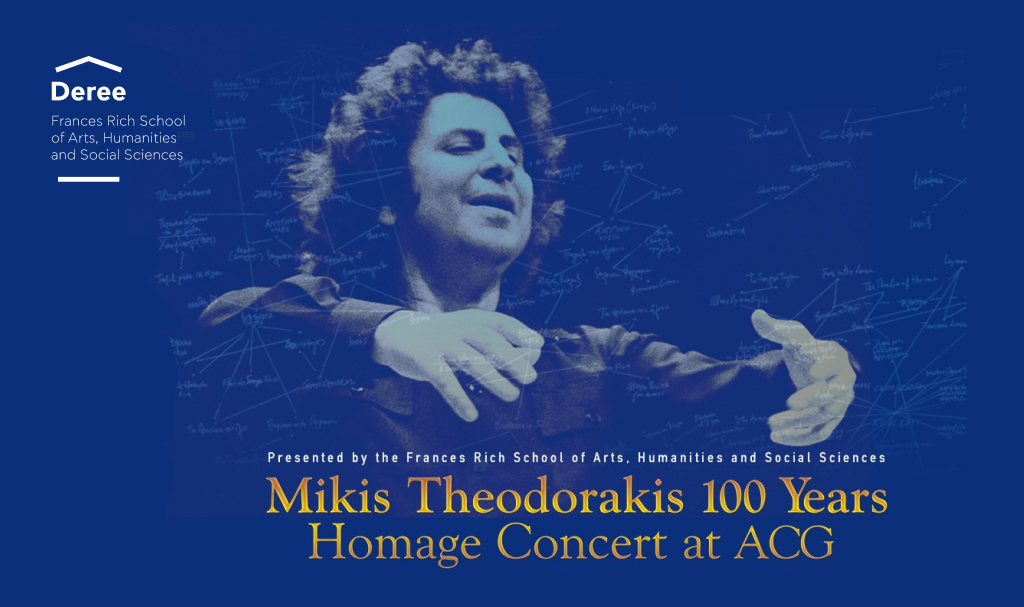
202502Dec19:0021:30Mikis Theodorakis 100 Years | Homage Concert at ACGat Pierce Theater19:00 - 21:30
Event Details
When: Tuesday, December 2, 2025 | 19:00-21:30 Where: Pierce Theater, The American College of Greece, 6 Gravias Str., Aghia Paraskevi, Athens Organized by: Frances Rich School of Arts, Humanities, and Social Sciences, Deree
Event Details
When: Tuesday, December 2, 2025 | 19:00-21:30
Where: Pierce Theater, The American College of Greece, 6 Gravias Str., Aghia Paraskevi, Athens
Organized by:
Frances Rich School of Arts, Humanities, and Social Sciences, Deree – The American College of Greece
Featuring:
Kostas Triantafyllidis (voice), Tatiana Papageorgiou (piano, musical direction), Thanassis Vassilas & Yannis Matsoukas (bouzouki), an orchestra of distinguished soloists, and young singers from the Deree Music Program. Choral and vocal coaching is by Effi Minakoulis and Maira Milolidaki.
About the event
In 2025, Greece commemorates the centenary of the illustrious composer Mikis Theodorakis, a pivotal figure in the country’s post-war cultural history, as highlighted by the Culture Ministry’s dedication of the year to him. The Frances Rich School of Arts, Humanities, and Social Sciences of the American College of Greece will host a Homage Concert honoring his legacy. The concert will showcase a blend of distinguished professional musicians and longtime collaborators of Theodorakis alongside talented young performers from the Deree Music Program. The renowned singer Kostas Triantafyllidis will lead the performance, accompanied by pianist Tatiana Papageorgiou and bouzouki soloists Thanassis Vassilas and Yannis Matsoukas—all three close artistic associates of Theodorakis. The program will feature a selection of Theodorakis’ renowned songs and film scores, demonstrating the global resonance of his work, with his melodies have been sung in dozens of languages worldwide by artists such as the Beatles, Edith Piaf, Shirley Bassey, Albano, Milva, Livaneli, Arja Saijonma and Joan Baez. The evening will be a moving celebration of Theodorakis’s universal messages of freedom, peace and solidarity through music.
The concert is open to the public with free admission.
Registration is recommended. Please register below to confirm your seat.
For further information, please contact [email protected]
October
Event Details
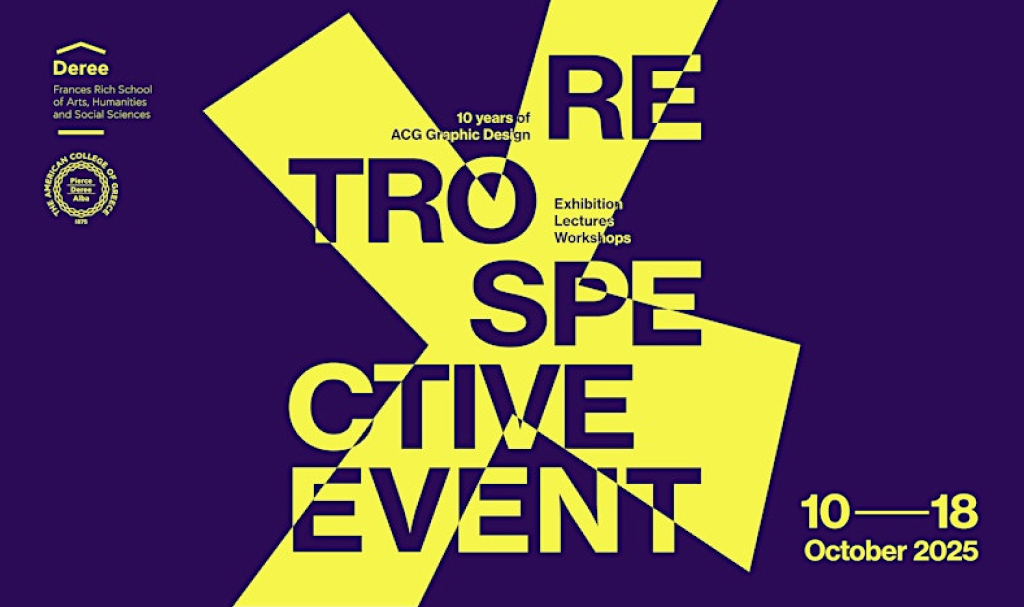
An Exhibition and Symposium on Theory and Practice in Graphic Design Organized by: Graphic Design Program Faculty, Arts and Creative Industries Department, The American College of Greece Venue: ACG Plaka building, 17B
Event Details
An Exhibition and Symposium on Theory and Practice in Graphic Design
Organized by: Graphic Design Program Faculty, Arts and Creative Industries Department, The American College of Greece
Venue: ACG Plaka building, 17B Ipitou Street, Athens
Event Launch and Exhibition Opening: Friday, October 10, 2025, 18:30–21:00
Exhibition Dates: October 10–18, 2025
- Friday: October 10: 18:30–21:00
- Weekdays: 15:00–18:00
- Saturdays: 15:00–20:30
- Sundays: Closed
Symposium: Saturday, October 11 & Saturday, October 18, 2025, 15:00–20:30
Opening and Launch of Exhibition
Friday, October 10, 2025
Demos Center, 1st Floor | 18:30–21:00
- Design Legacies: Founding faculty reflections
- Design Journeys: Alumni voices
- Celebrating the Student Design Exhibition

Symposium (Part 1)
Saturday, October 11, 2025
Demos Center, 2nd Floor | 15:00–20:30
Graphic Design in Retrospect: A Decade of Shifts
- Keynote Speaker Agne Katzouraki
- Lectures exploring how design trends, technologies, and priorities have evolved since 2015
- Workshop: “Innovation Remix: Design Thinking + Generative AI”
Symposium (Part 2)
Saturday, October 18, 2025
Demos Center, 2nd Floor | 15:00–20:30
Graphic Design Futures: Practice in Transition
- Keynote Speaker Vouvoula Skoura
- Lectures on contemporary approaches and emerging directions in design
- Workshop: “Next-Gen Tools for Designers: Unlocking Creativity in Immersive Worlds”
Overview
10 Years of Graphic Design at Deree – Looking Back, Moving Forward
Celebrate a decade of creativity and innovation at our in-person event! Join us at Demos Center (Ipitou 17) as we review the past, reflect on the present, and look towards the future of graphic design. Meet industry professionals, network with fellow designers and alumni, and gain insights into the ever-evolving world of visual communication. Don’t miss out on this unique opportunity to be part of a celebration in the graphic design community!
The celebration will include a Student Exhibition (10-18 Oct, check for opening hours) showcasing student work (past and present), to be launched on Friday, 10 October, at 18:30. A two-part Symposium will take place on Saturday, October 11 and Saturday, October 18 (from 15.00-20.30) featuring expert lectures on past, contemporary and future design practice, alumni sharing their journeys and experiences after graduation, and hands-on Workshops exploring topics such as Gen AI in Design Thinking, and emerging creative tools like virtual reality.
Whether you’re a practicing designer, an educator, a student, or simply passionate about visual culture, this is a unique opportunity to engage with the ideas, tools, and people shaping the future of design. Reserve your spot now and be part of this special moment for our community.
Photography and video recording may take place during the event for documentation and promotional purposes. By attending, you consent to being photographed and/or recorded. If you prefer not to appear in any photos or videos, please inform a member of the event staff upon arrival.

September

Event Details
Exhibition duration: Monday 14 July- Thursday 31 July | Monday 1 September- Saturday 27 September Opening hours: Monday- Friday, 15:00-19:00, Saturday, 12:00-18:00 Where: 17 Ipitou St., Plaka, Athens, 105 57 Curated
Event Details
Exhibition duration: Monday 14 July- Thursday 31 July | Monday 1 September- Saturday 27 September
Opening hours: Monday- Friday, 15:00-19:00, Saturday, 12:00-18:00
Where:
17 Ipitou St., Plaka, Athens, 105 57
Curated by
Dr. Tamara Chalabi
Organized by:
The Frances Rich School of Arts, Humanities and Social Sciences,
The American College of Greece
And
The Demos Center,
The American College of Greece
About the exhibition
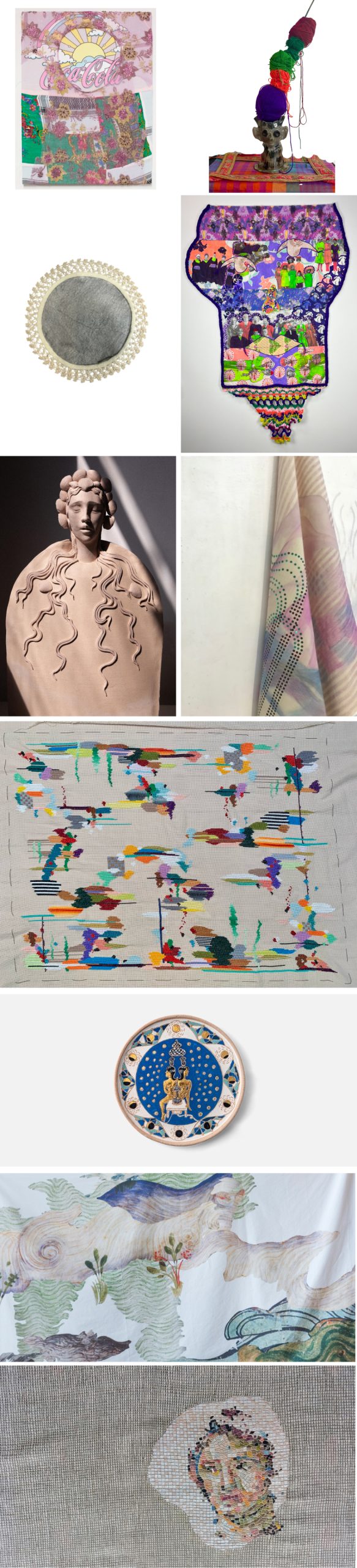
Clay and textile—two of humanity’s most ancient and eloquent materials—serve as profound witnesses to human experience. Through impression, weave, and mark, these materials preserve intimate traces of touch and intention, creating permanent records of gesture across time. This exhibition brings together ten contemporary artists from the Mediterranean, Middle East, and their diasporas who harness these materials’ inherent capacity for memory and testimony.
The relationship between clay and textile is deeply entwined in human cultural memory. From the impressed patterns on ancient vessels to the encoded narratives in traditional weaving, these materials have long served as repositories of cultural knowledge and technical innovation. This is most poetically embodied in the Sleeping Lady of Malta—a Neolithic clay figurine who’s carefully rendered drapery speaks to humanity’s enduring impulse to document both form and fabric.
The artists presented here extend this legacy, transforming these ancient mediums into contemporary testimonies of identity, displacement, belonging, and cultural preservation.
The selected works, including several new commissions, demonstrate diverse approaches to material testimony:
Paolo Colombo’s commissioned works for ITERARTE embrace the Chamba Rumal tradition—a 17th-century embroidery technique once practiced by Himalayan royal women—where silk threads transform muslin into intricate narratives. His signature visual language of lines, dots, and squares, originally inspired by Byzantine and Classical mosaics, finds new resonance through thread. The embroidered works extend his meditative practice into textile form, where each stitch echoes the precise geometry of his compositions while engaging with living craft traditions of the Indian subcontinent.
Iliodora Margellos engages deeply with embroidery’s dual heritage as domestic craft and tool of resistance. Her meticulously stitched works, developed over months of patient labor, break free from traditional grid structures to create emotional landscapes that reveal themselves differently from afar and in intimate proximity. Analepsis (After the Mares) exemplifies this approach, while “Hope, a Field of Poppies”—created in collaboration with INAASH through ITERARTE—connects her practice to Palestinian refugee women in Lebanon, acknowledging embroidery’s ongoing role as a portable medium of cultural preservation and resistance. Each stitch in her work becomes a meditation on nature’s forms and a testament to embroidery’s enduring power as both personal expression and political witness.
Majd Abdel Hamid in newly commissioned and existing work reuses works on fabric and embroidery, to underline the multifaceted dimensions of use, inviting the viewer to join him in rethinking notions of memory, trauma and psychological nuances as an ongoing archive of existence. His work transforms materials into records of human experience, challenging conventional approaches to documentation.
The ceramic works of Elif Uras and Tancredi di Carcaci investigate how traditional forms carry contemporary cultural tensions. Working between New York and Iznik—the historic center of Ottoman ceramic production—Uras creates wheel-thrown plate paintings that bridge ceramics and textile patterns, underlining female labor and class through traditional techniques and contemporary sensibility. Di Carcaci employs the ancient practice of spolia—the repurposing of architectural fragments—as a metaphor for our shifting relationship with the sacred, examining how contemporary forms of idolatry emerge from the ruins of religious imagery.
Francesco Simeti’s deeply layered works draw on social, philosophical, and environmental discourses, particularly exploring water’s dual nature through site-specific digital collages and textile installations. Through layered imagery that incorporates historical and contemporary sources, his works map the transformation of natural landscapes, using fabric’s inherent mutability to reflect on ecological shifts and human intervention.
Through a dynamic fusion of sequins, gouache, and graphite, Lydia Delikoura’s works explore the bonds between humans, creatures, and landscape. She creates harmonious spaces where shimmering elements—both natural and synthetic—interweave with themes of sisterhood and impossible love, drawing inspiration from classical mythology. This investigation extends into her ITERARTE collaborations, where paintings are transformed into functional objects like stools, challenging conventional distinctions between fine art and design while preserving traces of material evolution.
Through a dynamic fusion of sequins, gouache, and graphite, Lydia Delikoura’s works explore the bonds between humans, creatures, and landscape. She creates harmonious spaces where shimmering elements—both natural and synthetic—interweave with themes of sisterhood and impossible love, drawing inspiration from classical mythology. This investigation extends into her ITERARTE collaborations, where paintings are transformed into functional objects like stools, challenging conventional distinctions between fine art and design while preserving traces of material evolution.
Hale Ekinci transforms domestic textiles into repositories of immigrant memory, merging Middle Eastern and Western traditions through a distinctive process of repurposing family photographs. In her newly commissioned Under One Roof (2025) installation and earlier works like Travel Pillow Necklace (2023) and Apron (2022), she obscures faces with French knots and overlays traditional Middle Eastern patterns with contemporary Western symbols. Influenced by Turkish Oya—meaningful lace edgings on headscarves traditionally used by women for non-verbal communication—the piece features exaggerated, colourful crochet edges resembling paragraphs or letters, encoding messages in their own right.
Afsoon’s ceramic vessels navigate between function and storytelling, drawing on her transcultural journey from Iran through California to London Fools and Devils (2025) transforms traditional Persian vessels into contemporary narratives. Each piece merges cultural symbols with talisman-like elements, reimagining an ancient tale of innocence and temptation through the lens of diasporic identity.
Nuveen Barwari’s work materializes the complexities of Kurdish-American identity through textile interventions. In Cola and Chiya, she pairs references to Kurdish mountains with Coca-Cola imagery, creating a charged dialogue between traditional and contemporary cultural symbols. Her architectural window installations, constructed from four traditional Kurdish dresses representing Kurdistan’s regions, transform intimate garments into monumental structures that speak to both fragmentation and preservation of cultural heritage across borders.
Through these diverse approaches, clay and textile emerge not merely as artistic media but as active participants in the preservation and transformation of cultural memory. Each work serves as both witness and testimony, speaking to the enduring power of materials to carry forward human stories across time and geography.
Participating artists: Afsoon, Nuveen Barwari, Tancredi di Carcaci, Paolo Colombo, Lydia Delikoura, Hale Ekinci, Majd Abdel Hamid, Iliodora Margellos, Francesco Simeti, Elif Uras.
About Tamara Chalabi
Dr. Tamara Chalabi is a cultural historian, curator, and founder of multiple pioneering art initiatives; ITERARTE and the RUYA Foundation. Her curatorial practice spans the Mediterranean to India, where she has established dynamic conversations for contemporary art and cultural exchange. Notable projects include commissioning four national Iraqi Pavilions at the Venice Biennale. Dr. Chalabi holds a PhD from Harvard University and has published extensively on cultural heritage. Her latest project, Material Witnesses explores intersections between historical materiality and contemporary artistic practice.
About ITERARTE
ITERARTE is a platform for artists focused on storytelling that bridges cross cultural dialogue across the Mediterranean to India; a magazine and shop connecting artists and artisans to collectors. Derived from the Latin word for journey (iter), through exhibitions, collaborations and online, ITERARTE showcases lands that lie between the Mediterranean Sea and India, including the Middle East.
Through its Variations project, it exemplifies this mission by uniting contemporary artists with traditional craftspeople to create unique reinterpretations of existing works through techniques like embroidery and weaving. Through both its publications and commissioned pieces, ITERARTE preserves and reimagines cultural heritage while fostering dialogue between artists, collectors, and audiences across Europe, Africa, and Asia.
About The Frances Rich School of Arts, Humanities and Social Sciences
 The Frances Rich School of Arts, Humanities and Social Sciences offers a dynamic curriculum designed to cultivate the student’s critical mind and creative potential, while preparing them for success in the social and professional arenas. At a time of global unrest, marked by economic inequalities, the rise of artificial intelligence, and climate change, arts, humanities and social sciences education takes center stage in any higher education institution that caters to the present while looking to the future. In line with our vision and mission, our humanities and social sciences programs offer a broad as well as in-depth exposure to knowledge that fosters refined understanding, global consciousness, and ability to deploy creative synthesis, which is the foundation of critical, innovative thought. Our arts programs, run by distinguished academics and practitioners, offer a well-rounded arts education that blends theoretical knowledge with practical training and rich opportunities for creative self-expression.
About Demos Center
 The Demos Center of The American College of Greece is a place where we strengthen democracy by encouraging active citizenship. This is reflected in its mission, partnerships and programing. Located in the heart of Plaka, the Center hosts exhibitions, debates, and cultural programs that strengthen democratic values and active citizenship. Through diverse programming and community partnerships, Demos creates space for cross-cultural exchange and civic participation. The Demos’s motto is “devote the rest of your life to making progress” and in that sentiment encourage the youth of Athens to come to The Demos Center to be inspired and energized.
August
Event Details
Exhibition duration: Monday 14 July- Thursday 31 July | Monday 1 September- Saturday 27 September Opening hours: Monday- Friday, 15:00-19:00, Saturday, 12:00-18:00 Where: 17 Ipitou St., Plaka, Athens, 105 57 Curated
Event Details
Exhibition duration: Monday 14 July- Thursday 31 July | Monday 1 September- Saturday 27 September
Opening hours: Monday- Friday, 15:00-19:00, Saturday, 12:00-18:00
Where:
17 Ipitou St., Plaka, Athens, 105 57
Curated by
Dr. Tamara Chalabi
Organized by:
The Frances Rich School of Arts, Humanities and Social Sciences,
The American College of Greece
And
The Demos Center,
The American College of Greece
About the exhibition
Clay and textile—two of humanity’s most ancient and eloquent materials—serve as profound witnesses to human experience. Through impression, weave, and mark, these materials preserve intimate traces of touch and intention, creating permanent records of gesture across time. This exhibition brings together ten contemporary artists from the Mediterranean, Middle East, and their diasporas who harness these materials’ inherent capacity for memory and testimony.
The relationship between clay and textile is deeply entwined in human cultural memory. From the impressed patterns on ancient vessels to the encoded narratives in traditional weaving, these materials have long served as repositories of cultural knowledge and technical innovation. This is most poetically embodied in the Sleeping Lady of Malta—a Neolithic clay figurine who’s carefully rendered drapery speaks to humanity’s enduring impulse to document both form and fabric.
The artists presented here extend this legacy, transforming these ancient mediums into contemporary testimonies of identity, displacement, belonging, and cultural preservation.
The selected works, including several new commissions, demonstrate diverse approaches to material testimony:
Paolo Colombo’s commissioned works for ITERARTE embrace the Chamba Rumal tradition—a 17th-century embroidery technique once practiced by Himalayan royal women—where silk threads transform muslin into intricate narratives. His signature visual language of lines, dots, and squares, originally inspired by Byzantine and Classical mosaics, finds new resonance through thread. The embroidered works extend his meditative practice into textile form, where each stitch echoes the precise geometry of his compositions while engaging with living craft traditions of the Indian subcontinent.
Iliodora Margellos engages deeply with embroidery’s dual heritage as domestic craft and tool of resistance. Her meticulously stitched works, developed over months of patient labor, break free from traditional grid structures to create emotional landscapes that reveal themselves differently from afar and in intimate proximity. Analepsis (After the Mares) exemplifies this approach, while “Hope, a Field of Poppies”—created in collaboration with INAASH through ITERARTE—connects her practice to Palestinian refugee women in Lebanon, acknowledging embroidery’s ongoing role as a portable medium of cultural preservation and resistance. Each stitch in her work becomes a meditation on nature’s forms and a testament to embroidery’s enduring power as both personal expression and political witness.
Majd Abdel Hamid in newly commissioned and existing work reuses works on fabric and embroidery, to underline the multifaceted dimensions of use, inviting the viewer to join him in rethinking notions of memory, trauma and psychological nuances as an ongoing archive of existence. His work transforms materials into records of human experience, challenging conventional approaches to documentation.
The ceramic works of Elif Uras and Tancredi di Carcaci investigate how traditional forms carry contemporary cultural tensions. Working between New York and Iznik—the historic center of Ottoman ceramic production—Uras creates wheel-thrown plate paintings that bridge ceramics and textile patterns, underlining female labor and class through traditional techniques and contemporary sensibility. Di Carcaci employs the ancient practice of spolia—the repurposing of architectural fragments—as a metaphor for our shifting relationship with the sacred, examining how contemporary forms of idolatry emerge from the ruins of religious imagery.
Francesco Simeti’s deeply layered works draw on social, philosophical, and environmental discourses, particularly exploring water’s dual nature through site-specific digital collages and textile installations. Through layered imagery that incorporates historical and contemporary sources, his works map the transformation of natural landscapes, using fabric’s inherent mutability to reflect on ecological shifts and human intervention.
Through a dynamic fusion of sequins, gouache, and graphite, Lydia Delikoura’s works explore the bonds between humans, creatures, and landscape. She creates harmonious spaces where shimmering elements—both natural and synthetic—interweave with themes of sisterhood and impossible love, drawing inspiration from classical mythology. This investigation extends into her ITERARTE collaborations, where paintings are transformed into functional objects like stools, challenging conventional distinctions between fine art and design while preserving traces of material evolution.
Through a dynamic fusion of sequins, gouache, and graphite, Lydia Delikoura’s works explore the bonds between humans, creatures, and landscape. She creates harmonious spaces where shimmering elements—both natural and synthetic—interweave with themes of sisterhood and impossible love, drawing inspiration from classical mythology. This investigation extends into her ITERARTE collaborations, where paintings are transformed into functional objects like stools, challenging conventional distinctions between fine art and design while preserving traces of material evolution.
Hale Ekinci transforms domestic textiles into repositories of immigrant memory, merging Middle Eastern and Western traditions through a distinctive process of repurposing family photographs. In her newly commissioned Under One Roof (2025) installation and earlier works like Travel Pillow Necklace (2023) and Apron (2022), she obscures faces with French knots and overlays traditional Middle Eastern patterns with contemporary Western symbols. Influenced by Turkish Oya—meaningful lace edgings on headscarves traditionally used by women for non-verbal communication—the piece features exaggerated, colourful crochet edges resembling paragraphs or letters, encoding messages in their own right.
Afsoon’s ceramic vessels navigate between function and storytelling, drawing on her transcultural journey from Iran through California to London Fools and Devils (2025) transforms traditional Persian vessels into contemporary narratives. Each piece merges cultural symbols with talisman-like elements, reimagining an ancient tale of innocence and temptation through the lens of diasporic identity.
Nuveen Barwari’s work materializes the complexities of Kurdish-American identity through textile interventions. In Cola and Chiya, she pairs references to Kurdish mountains with Coca-Cola imagery, creating a charged dialogue between traditional and contemporary cultural symbols. Her architectural window installations, constructed from four traditional Kurdish dresses representing Kurdistan’s regions, transform intimate garments into monumental structures that speak to both fragmentation and preservation of cultural heritage across borders.
Through these diverse approaches, clay and textile emerge not merely as artistic media but as active participants in the preservation and transformation of cultural memory. Each work serves as both witness and testimony, speaking to the enduring power of materials to carry forward human stories across time and geography.
Participating artists: Afsoon, Nuveen Barwari, Tancredi di Carcaci, Paolo Colombo, Lydia Delikoura, Hale Ekinci, Majd Abdel Hamid, Iliodora Margellos, Francesco Simeti, Elif Uras.
About Tamara Chalabi
Dr. Tamara Chalabi is a cultural historian, curator, and founder of multiple pioneering art initiatives; ITERARTE and the RUYA Foundation. Her curatorial practice spans the Mediterranean to India, where she has established dynamic conversations for contemporary art and cultural exchange. Notable projects include commissioning four national Iraqi Pavilions at the Venice Biennale. Dr. Chalabi holds a PhD from Harvard University and has published extensively on cultural heritage. Her latest project, Material Witnesses explores intersections between historical materiality and contemporary artistic practice.
About ITERARTE
ITERARTE is a platform for artists focused on storytelling that bridges cross cultural dialogue across the Mediterranean to India; a magazine and shop connecting artists and artisans to collectors. Derived from the Latin word for journey (iter), through exhibitions, collaborations and online, ITERARTE showcases lands that lie between the Mediterranean Sea and India, including the Middle East.
Through its Variations project, it exemplifies this mission by uniting contemporary artists with traditional craftspeople to create unique reinterpretations of existing works through techniques like embroidery and weaving. Through both its publications and commissioned pieces, ITERARTE preserves and reimagines cultural heritage while fostering dialogue between artists, collectors, and audiences across Europe, Africa, and Asia.
About The Frances Rich School of Arts, Humanities and Social Sciences
The Frances Rich School of Arts, Humanities and Social Sciences offers a dynamic curriculum designed to cultivate the student’s critical mind and creative potential, while preparing them for success in the social and professional arenas. At a time of global unrest, marked by economic inequalities, the rise of artificial intelligence, and climate change, arts, humanities and social sciences education takes center stage in any higher education institution that caters to the present while looking to the future. In line with our vision and mission, our humanities and social sciences programs offer a broad as well as in-depth exposure to knowledge that fosters refined understanding, global consciousness, and ability to deploy creative synthesis, which is the foundation of critical, innovative thought. Our arts programs, run by distinguished academics and practitioners, offer a well-rounded arts education that blends theoretical knowledge with practical training and rich opportunities for creative self-expression.
About Demos Center
The Demos Center of The American College of Greece is a place where we strengthen democracy by encouraging active citizenship. This is reflected in its mission, partnerships and programing. Located in the heart of Plaka, the Center hosts exhibitions, debates, and cultural programs that strengthen democratic values and active citizenship. Through diverse programming and community partnerships, Demos creates space for cross-cultural exchange and civic participation. The Demos’s motto is “devote the rest of your life to making progress” and in that sentiment encourage the youth of Athens to come to The Demos Center to be inspired and energized.
July
202507Jul20:00Where cultures meet in soundPiano Recital for 220:00
Event Details
When: Monday, July 7, 20:00 Where: 7th Level Auditorium, The American College of Greece Free Admission - Open to the public Organized by: The Music Program of Frances Rich School of Fine and
Event Details
When: Monday, July 7, 20:00
Where: 7th Level Auditorium, The American College of Greece
Free Admission – Open to the public
Organized by:
The Music Program of Frances Rich School of Fine and Performing Arts
About the event
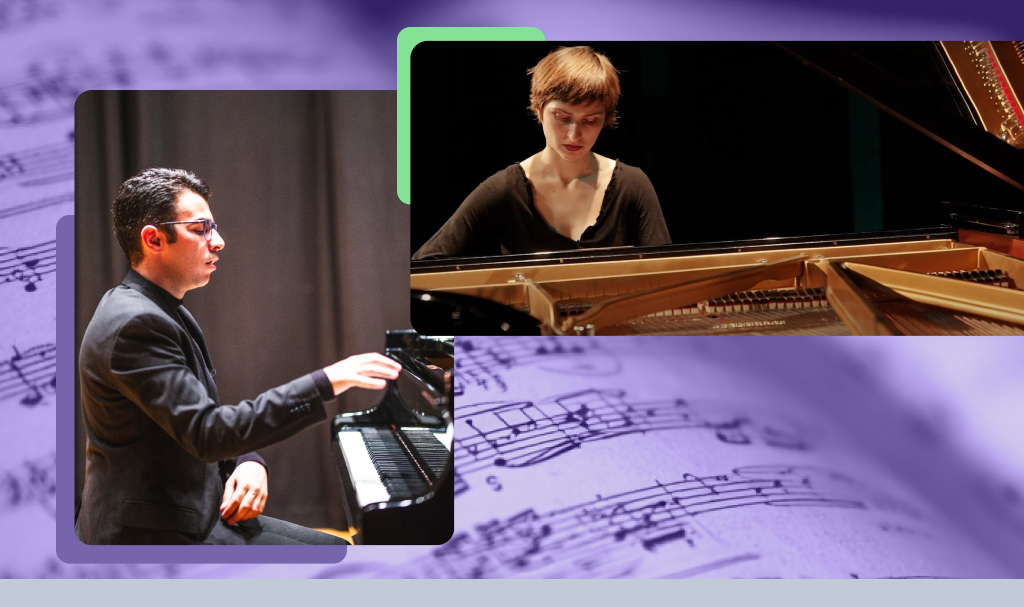
Pianists Vassilis Gavvaris (D’23) and Tatiana Nikolopoulou come together for a captivating evening that celebrates the piano’s ability to transcend cultures, traditions, and eras. This program for solo piano and piano four hands spans centuries of musical evolution, weaving a narrative of passion, reflection, and imagination.
The concert opens with the impetuous and emotionally charged world of Robert Schumann, whose music balances stormy intensity with lyrical tenderness. From there, the journey moves to Beach’s variations inspired by Balkan folk melodies, offering rhythmic complexity and vibrant colors. Listeners will be drawn into the introspective depth of Beethoven’s late piano sonatas, where quiet contemplation gradually blossoms into determination and clarity, elevating personal expression into a universal spiritual statement. At the heart of the program is Chopin’s most celebrated Ballade, where intricate, lyrical lines evoke dreams, trauma, and deeply personal emotions. This is followed by Prokofiev, whose stark contrasts—tense rhythms, melancholic waltzes, and explosive developments—paint a landscape of conflict and resolution. The evening continues with 20th-century works inspired by the awe of nature and the human hardships, culminating in a luminous and playful summer finale by American composer Amy Beach’s four-hands work.
Join us for an evening where tradition meets innovation, and where two young pianists unite to bring a rich and soulful repertoire to life.
Biographies of the pianists
Tatiana Nikolopoulou was born in Athens and began playing the piano at the age of 6. She is a graduate of the University of Macedonia, specializing in Piano under the guidance of Professor Igor Petrin. She has completed the postgraduate program (M.A.) of the University of Macedonia as well as the Piano Performance program of the Royal Academy of Music in Stockholm. She has given recitals in various cities in Greece, Bulgaria, Sweden, and Iceland at distinguished venues such as Engelbrektskyrkan, the Athens Conservatoire, the Thessaloniki Concert Hall, the Archaeological Museum of Thessaloniki, Kungasalen KMH, Sala Europa/Ruse, the Center of Mediterranean Architecture in Chania, the University of the Arts in Reykjavik, the Austrian Ambassador’s Residence, among others. She has been awarded in the “Ilias Kouskouvelis” performance competition and has performed as a soloist with the University of Macedonia’s orchestra. She has attended seminars and masterclasses with Arturs Cingujevs, Janos Balazs, Ilya Kondratiev, Antti Hotti, Peter Nagy, Mats Widlund, Maria Asteriadou, Ksenia Nosikova, Nikos Zafranas, Florent Boffard, Leniο Liatsou, Pablo Galdo, Sergey Sarajyan, and Iwona Glinka. Finally, since the academic year 2024, she has been teaching piano at the Music School of Mytilene.
 Vassilis Gavvaris is a 24-year-old pianist of Greek and Cypriot descent. Currently, he is pursuing his master’s at Conservatorium Maastricht under Dr. Katia Veekmans. He graduated with top honours and the “Outstanding Graduate Award” from The American College of Greece, where he studied under Dr. Tatiana Papageorgiou as a “Frances Rich” scholar, while he has also earned his National Piano Soloist’s Diploma with top honours and the first prize. Vassilis began his piano journey at the age of 13 at the National Conservatory of Sparta—his hometown—studying with Maria Velmachou. A postgraduate scholar of the A.G. Leventis Foundation and the Greek Ship-Owners Union (“Onassis Scholarship”), he has been awarded for his interpretations and artistic activity. Most notably, he earned the “Audience Prize Award” while being one of the four finalists of the “Maastricht Music Award” (Piano Edition 2025). In 2024, he received the “Emerging Soloist Award” from the Gina Bachauer International Music Association. Other awards include the second prize at the Filonas and Chaerogiorgou-Sigara Piano Competitions, first prize at the Felouris Competition, and a merit award at the Montecatini International Piano Competition. Vassilis has participated in masterclasses with renowned pianists and professors, such as Nikolai Lugansky, Jorge Luis Prats, Andrzej Jasiński, Péter Nagy, Martino Tirimo, Dimitri Toufexis, and Jean-Louis Steuerman. He has performed at venues in Greece, the Netherlands, and Sweden, including Megaron-The Athens Concert Hall, Theater Heerlen, the Acropolis of Ancient Sparta, and Nathan Milstainsalen in Stockholm, as well as at festivals such as the Gina Bachauer and Athens Piano City Festivals, Akademifestivalen Stockholm, Moving Music Festival Maastricht, and during the Cyprus Independence Day celebrations. In May 2025, Vassilis collaborated as a soloist with the Conservatorium Maastricht’s Orchestra. He is also passionate about chamber music, teaching, and piano repertoire from his native countries. In addition, Vassilis holds a bachelor’s in psychology from Panteion University.
Event Details
Exhibition duration: Monday 14 July- Thursday 31 July | Monday 1 September- Saturday 27 September Opening hours: Monday- Friday, 15:00-19:00, Saturday, 12:00-18:00 Where: 17 Ipitou St., Plaka, Athens, 105 57 Curated
Event Details
Exhibition duration: Monday 14 July- Thursday 31 July | Monday 1 September- Saturday 27 September
Opening hours: Monday- Friday, 15:00-19:00, Saturday, 12:00-18:00
Where:
17 Ipitou St., Plaka, Athens, 105 57
Curated by
Dr. Tamara Chalabi
Organized by:
The Frances Rich School of Arts, Humanities and Social Sciences,
The American College of Greece
And
The Demos Center,
The American College of Greece
About the exhibition
Clay and textile—two of humanity’s most ancient and eloquent materials—serve as profound witnesses to human experience. Through impression, weave, and mark, these materials preserve intimate traces of touch and intention, creating permanent records of gesture across time. This exhibition brings together ten contemporary artists from the Mediterranean, Middle East, and their diasporas who harness these materials’ inherent capacity for memory and testimony.
The relationship between clay and textile is deeply entwined in human cultural memory. From the impressed patterns on ancient vessels to the encoded narratives in traditional weaving, these materials have long served as repositories of cultural knowledge and technical innovation. This is most poetically embodied in the Sleeping Lady of Malta—a Neolithic clay figurine who’s carefully rendered drapery speaks to humanity’s enduring impulse to document both form and fabric.
The artists presented here extend this legacy, transforming these ancient mediums into contemporary testimonies of identity, displacement, belonging, and cultural preservation.
The selected works, including several new commissions, demonstrate diverse approaches to material testimony:
Paolo Colombo’s commissioned works for ITERARTE embrace the Chamba Rumal tradition—a 17th-century embroidery technique once practiced by Himalayan royal women—where silk threads transform muslin into intricate narratives. His signature visual language of lines, dots, and squares, originally inspired by Byzantine and Classical mosaics, finds new resonance through thread. The embroidered works extend his meditative practice into textile form, where each stitch echoes the precise geometry of his compositions while engaging with living craft traditions of the Indian subcontinent.
Iliodora Margellos engages deeply with embroidery’s dual heritage as domestic craft and tool of resistance. Her meticulously stitched works, developed over months of patient labor, break free from traditional grid structures to create emotional landscapes that reveal themselves differently from afar and in intimate proximity. Analepsis (After the Mares) exemplifies this approach, while “Hope, a Field of Poppies”—created in collaboration with INAASH through ITERARTE—connects her practice to Palestinian refugee women in Lebanon, acknowledging embroidery’s ongoing role as a portable medium of cultural preservation and resistance. Each stitch in her work becomes a meditation on nature’s forms and a testament to embroidery’s enduring power as both personal expression and political witness.
Majd Abdel Hamid in newly commissioned and existing work reuses works on fabric and embroidery, to underline the multifaceted dimensions of use, inviting the viewer to join him in rethinking notions of memory, trauma and psychological nuances as an ongoing archive of existence. His work transforms materials into records of human experience, challenging conventional approaches to documentation.
The ceramic works of Elif Uras and Tancredi di Carcaci investigate how traditional forms carry contemporary cultural tensions. Working between New York and Iznik—the historic center of Ottoman ceramic production—Uras creates wheel-thrown plate paintings that bridge ceramics and textile patterns, underlining female labor and class through traditional techniques and contemporary sensibility. Di Carcaci employs the ancient practice of spolia—the repurposing of architectural fragments—as a metaphor for our shifting relationship with the sacred, examining how contemporary forms of idolatry emerge from the ruins of religious imagery.
Francesco Simeti’s deeply layered works draw on social, philosophical, and environmental discourses, particularly exploring water’s dual nature through site-specific digital collages and textile installations. Through layered imagery that incorporates historical and contemporary sources, his works map the transformation of natural landscapes, using fabric’s inherent mutability to reflect on ecological shifts and human intervention.
Through a dynamic fusion of sequins, gouache, and graphite, Lydia Delikoura’s works explore the bonds between humans, creatures, and landscape. She creates harmonious spaces where shimmering elements—both natural and synthetic—interweave with themes of sisterhood and impossible love, drawing inspiration from classical mythology. This investigation extends into her ITERARTE collaborations, where paintings are transformed into functional objects like stools, challenging conventional distinctions between fine art and design while preserving traces of material evolution.
Through a dynamic fusion of sequins, gouache, and graphite, Lydia Delikoura’s works explore the bonds between humans, creatures, and landscape. She creates harmonious spaces where shimmering elements—both natural and synthetic—interweave with themes of sisterhood and impossible love, drawing inspiration from classical mythology. This investigation extends into her ITERARTE collaborations, where paintings are transformed into functional objects like stools, challenging conventional distinctions between fine art and design while preserving traces of material evolution.
Hale Ekinci transforms domestic textiles into repositories of immigrant memory, merging Middle Eastern and Western traditions through a distinctive process of repurposing family photographs. In her newly commissioned Under One Roof (2025) installation and earlier works like Travel Pillow Necklace (2023) and Apron (2022), she obscures faces with French knots and overlays traditional Middle Eastern patterns with contemporary Western symbols. Influenced by Turkish Oya—meaningful lace edgings on headscarves traditionally used by women for non-verbal communication—the piece features exaggerated, colourful crochet edges resembling paragraphs or letters, encoding messages in their own right.
Afsoon’s ceramic vessels navigate between function and storytelling, drawing on her transcultural journey from Iran through California to London Fools and Devils (2025) transforms traditional Persian vessels into contemporary narratives. Each piece merges cultural symbols with talisman-like elements, reimagining an ancient tale of innocence and temptation through the lens of diasporic identity.
Nuveen Barwari’s work materializes the complexities of Kurdish-American identity through textile interventions. In Cola and Chiya, she pairs references to Kurdish mountains with Coca-Cola imagery, creating a charged dialogue between traditional and contemporary cultural symbols. Her architectural window installations, constructed from four traditional Kurdish dresses representing Kurdistan’s regions, transform intimate garments into monumental structures that speak to both fragmentation and preservation of cultural heritage across borders.
Through these diverse approaches, clay and textile emerge not merely as artistic media but as active participants in the preservation and transformation of cultural memory. Each work serves as both witness and testimony, speaking to the enduring power of materials to carry forward human stories across time and geography.
Participating artists: Afsoon, Nuveen Barwari, Tancredi di Carcaci, Paolo Colombo, Lydia Delikoura, Hale Ekinci, Majd Abdel Hamid, Iliodora Margellos, Francesco Simeti, Elif Uras.
About Tamara Chalabi
Dr. Tamara Chalabi is a cultural historian, curator, and founder of multiple pioneering art initiatives; ITERARTE and the RUYA Foundation. Her curatorial practice spans the Mediterranean to India, where she has established dynamic conversations for contemporary art and cultural exchange. Notable projects include commissioning four national Iraqi Pavilions at the Venice Biennale. Dr. Chalabi holds a PhD from Harvard University and has published extensively on cultural heritage. Her latest project, Material Witnesses explores intersections between historical materiality and contemporary artistic practice.
About ITERARTE
ITERARTE is a platform for artists focused on storytelling that bridges cross cultural dialogue across the Mediterranean to India; a magazine and shop connecting artists and artisans to collectors. Derived from the Latin word for journey (iter), through exhibitions, collaborations and online, ITERARTE showcases lands that lie between the Mediterranean Sea and India, including the Middle East.
Through its Variations project, it exemplifies this mission by uniting contemporary artists with traditional craftspeople to create unique reinterpretations of existing works through techniques like embroidery and weaving. Through both its publications and commissioned pieces, ITERARTE preserves and reimagines cultural heritage while fostering dialogue between artists, collectors, and audiences across Europe, Africa, and Asia.
About The Frances Rich School of Arts, Humanities and Social Sciences
The Frances Rich School of Arts, Humanities and Social Sciences offers a dynamic curriculum designed to cultivate the student’s critical mind and creative potential, while preparing them for success in the social and professional arenas. At a time of global unrest, marked by economic inequalities, the rise of artificial intelligence, and climate change, arts, humanities and social sciences education takes center stage in any higher education institution that caters to the present while looking to the future. In line with our vision and mission, our humanities and social sciences programs offer a broad as well as in-depth exposure to knowledge that fosters refined understanding, global consciousness, and ability to deploy creative synthesis, which is the foundation of critical, innovative thought. Our arts programs, run by distinguished academics and practitioners, offer a well-rounded arts education that blends theoretical knowledge with practical training and rich opportunities for creative self-expression.
About Demos Center
The Demos Center of The American College of Greece is a place where we strengthen democracy by encouraging active citizenship. This is reflected in its mission, partnerships and programing. Located in the heart of Plaka, the Center hosts exhibitions, debates, and cultural programs that strengthen democratic values and active citizenship. Through diverse programming and community partnerships, Demos creates space for cross-cultural exchange and civic participation. The Demos’s motto is “devote the rest of your life to making progress” and in that sentiment encourage the youth of Athens to come to The Demos Center to be inspired and energized.
June
202518Jun19:3021:00Performance of Aeschylus’ The Suppliant Women19:30 - 21:00
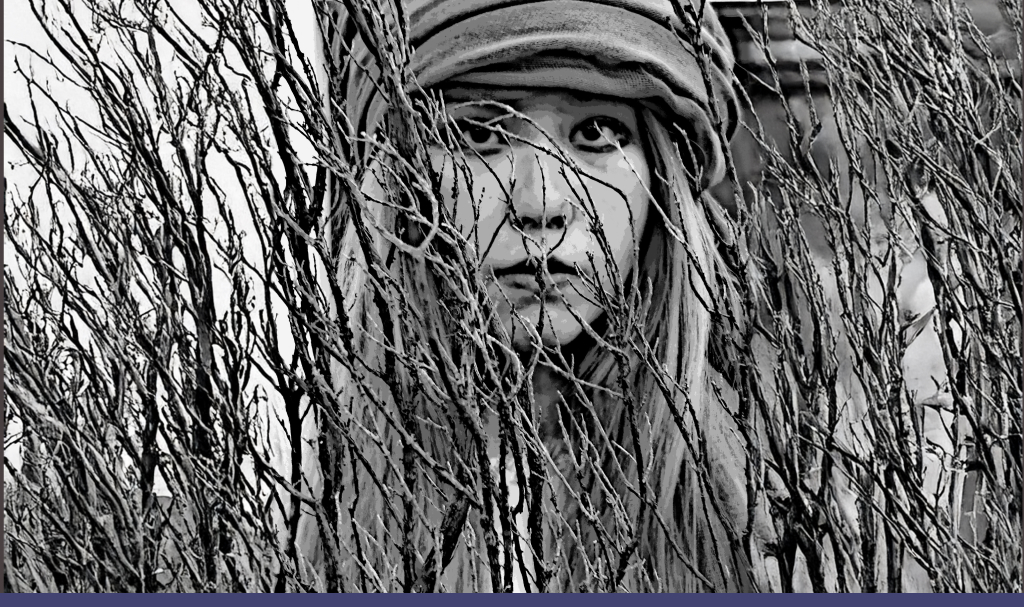
Event Details
When: Wednesday, June 18, 19:30-21:00 Where: Irene Bailey Open Air Theater, 6 Gravias Str., Aghia Paraskevi Organized by: Frances Rich School of Fine and Performing Arts, Deree – The American College of Greece About
Event Details
When: Wednesday, June 18, 19:30-21:00
Where: Irene Bailey Open Air Theater, 6 Gravias Str., Aghia Paraskevi
Organized by:
Frances Rich School of Fine and Performing Arts,
Deree – The American College of Greece
About the event
This is a performance of Aeschylus’ tragedy The Suppliant Women’ presented by the students of the Music Theater Workshop in collaboration with the Music and Theater Arts majors, under the musical and theatrical direction of Effie Minakoulis and movement direction of Katerina Drakopoulou. Piano accompaniment, Spyros Souladakis.
For more information, please contact [email protected]
202511Jun20:3022:00No Exit – New Music at ACG20:30 - 22:00
Event Details
When: Wednesday 11th June, 2025, 20:30–22:00 Where: Black Box Theater, The American College of Greece, 6 Gravias St. Agia Paraskevi Organized by: The Department of Music, Theater and Dance – The American College
Event Details
When: Wednesday 11th June, 2025, 20:30–22:00
Where: Black Box Theater, The American College of Greece, 6 Gravias St. Agia Paraskevi
Organized by:
The Department of Music, Theater and Dance – The American College of Greece
About the event
The leading US new music ensemble No Exit will begin their European Tour 2025 with a performance at The American College of Greece. A concert of innovative new music by one of the leading ensembles of the time, known for their artistic excellence, creating exiting, meaningful and thought-provoking programs that really allow an audience to connect with the experience. On this tour No Exit will play music by some of the most individual and poetic voices in new music today, with works from The Collective at the core of the program.
The event is free and open to the public. Parking on campus subject to availability.
For more information, please contact [email protected]
Agenda/Program and Bios of the Performers
Featuring music by Tim Beyer, Cindy Cox, Amy Kaplan, Douglas Knehans,
Konstantine Koukias, Pam Madsen, Spiros Mazis, Mathew Rosenblum,
Edward Smaldone, Jack Vees & Agata Zubel
No Exit are Cara Tweed (violin), Nicholas Diodore (cello), James Rhodes (violin), Sean Gabriel (flute), Gunnar Owen Hirthe (clarinet), Luke Rinderknecht (percussion), Rob Kovacs (piano) & Timothy Beyer (artistic director)
More information here about the composers involved
& here for details of the No Exit performers, the tour and program.
Event Details
Exhibition duration: Monday 14 July- Thursday 31 July | Monday 1 September- Saturday 27 September Opening hours: Monday- Friday, 15:00-19:00, Saturday, 12:00-18:00 Where: 17 Ipitou St., Plaka, Athens, 105 57 Curated
Event Details
Exhibition duration: Monday 14 July- Thursday 31 July | Monday 1 September- Saturday 27 September
Opening hours: Monday- Friday, 15:00-19:00, Saturday, 12:00-18:00
Where:
17 Ipitou St., Plaka, Athens, 105 57
Curated by
Dr. Tamara Chalabi
Organized by:
The Frances Rich School of Arts, Humanities and Social Sciences,
The American College of Greece
And
The Demos Center,
The American College of Greece
About the exhibition
Clay and textile—two of humanity’s most ancient and eloquent materials—serve as profound witnesses to human experience. Through impression, weave, and mark, these materials preserve intimate traces of touch and intention, creating permanent records of gesture across time. This exhibition brings together ten contemporary artists from the Mediterranean, Middle East, and their diasporas who harness these materials’ inherent capacity for memory and testimony.
The relationship between clay and textile is deeply entwined in human cultural memory. From the impressed patterns on ancient vessels to the encoded narratives in traditional weaving, these materials have long served as repositories of cultural knowledge and technical innovation. This is most poetically embodied in the Sleeping Lady of Malta—a Neolithic clay figurine who’s carefully rendered drapery speaks to humanity’s enduring impulse to document both form and fabric.
The artists presented here extend this legacy, transforming these ancient mediums into contemporary testimonies of identity, displacement, belonging, and cultural preservation.
The selected works, including several new commissions, demonstrate diverse approaches to material testimony:
Paolo Colombo’s commissioned works for ITERARTE embrace the Chamba Rumal tradition—a 17th-century embroidery technique once practiced by Himalayan royal women—where silk threads transform muslin into intricate narratives. His signature visual language of lines, dots, and squares, originally inspired by Byzantine and Classical mosaics, finds new resonance through thread. The embroidered works extend his meditative practice into textile form, where each stitch echoes the precise geometry of his compositions while engaging with living craft traditions of the Indian subcontinent.
Iliodora Margellos engages deeply with embroidery’s dual heritage as domestic craft and tool of resistance. Her meticulously stitched works, developed over months of patient labor, break free from traditional grid structures to create emotional landscapes that reveal themselves differently from afar and in intimate proximity. Analepsis (After the Mares) exemplifies this approach, while “Hope, a Field of Poppies”—created in collaboration with INAASH through ITERARTE—connects her practice to Palestinian refugee women in Lebanon, acknowledging embroidery’s ongoing role as a portable medium of cultural preservation and resistance. Each stitch in her work becomes a meditation on nature’s forms and a testament to embroidery’s enduring power as both personal expression and political witness.
Majd Abdel Hamid in newly commissioned and existing work reuses works on fabric and embroidery, to underline the multifaceted dimensions of use, inviting the viewer to join him in rethinking notions of memory, trauma and psychological nuances as an ongoing archive of existence. His work transforms materials into records of human experience, challenging conventional approaches to documentation.
The ceramic works of Elif Uras and Tancredi di Carcaci investigate how traditional forms carry contemporary cultural tensions. Working between New York and Iznik—the historic center of Ottoman ceramic production—Uras creates wheel-thrown plate paintings that bridge ceramics and textile patterns, underlining female labor and class through traditional techniques and contemporary sensibility. Di Carcaci employs the ancient practice of spolia—the repurposing of architectural fragments—as a metaphor for our shifting relationship with the sacred, examining how contemporary forms of idolatry emerge from the ruins of religious imagery.
Francesco Simeti’s deeply layered works draw on social, philosophical, and environmental discourses, particularly exploring water’s dual nature through site-specific digital collages and textile installations. Through layered imagery that incorporates historical and contemporary sources, his works map the transformation of natural landscapes, using fabric’s inherent mutability to reflect on ecological shifts and human intervention.
Through a dynamic fusion of sequins, gouache, and graphite, Lydia Delikoura’s works explore the bonds between humans, creatures, and landscape. She creates harmonious spaces where shimmering elements—both natural and synthetic—interweave with themes of sisterhood and impossible love, drawing inspiration from classical mythology. This investigation extends into her ITERARTE collaborations, where paintings are transformed into functional objects like stools, challenging conventional distinctions between fine art and design while preserving traces of material evolution.
Through a dynamic fusion of sequins, gouache, and graphite, Lydia Delikoura’s works explore the bonds between humans, creatures, and landscape. She creates harmonious spaces where shimmering elements—both natural and synthetic—interweave with themes of sisterhood and impossible love, drawing inspiration from classical mythology. This investigation extends into her ITERARTE collaborations, where paintings are transformed into functional objects like stools, challenging conventional distinctions between fine art and design while preserving traces of material evolution.
Hale Ekinci transforms domestic textiles into repositories of immigrant memory, merging Middle Eastern and Western traditions through a distinctive process of repurposing family photographs. In her newly commissioned Under One Roof (2025) installation and earlier works like Travel Pillow Necklace (2023) and Apron (2022), she obscures faces with French knots and overlays traditional Middle Eastern patterns with contemporary Western symbols. Influenced by Turkish Oya—meaningful lace edgings on headscarves traditionally used by women for non-verbal communication—the piece features exaggerated, colourful crochet edges resembling paragraphs or letters, encoding messages in their own right.
Afsoon’s ceramic vessels navigate between function and storytelling, drawing on her transcultural journey from Iran through California to London Fools and Devils (2025) transforms traditional Persian vessels into contemporary narratives. Each piece merges cultural symbols with talisman-like elements, reimagining an ancient tale of innocence and temptation through the lens of diasporic identity.
Nuveen Barwari’s work materializes the complexities of Kurdish-American identity through textile interventions. In Cola and Chiya, she pairs references to Kurdish mountains with Coca-Cola imagery, creating a charged dialogue between traditional and contemporary cultural symbols. Her architectural window installations, constructed from four traditional Kurdish dresses representing Kurdistan’s regions, transform intimate garments into monumental structures that speak to both fragmentation and preservation of cultural heritage across borders.
Through these diverse approaches, clay and textile emerge not merely as artistic media but as active participants in the preservation and transformation of cultural memory. Each work serves as both witness and testimony, speaking to the enduring power of materials to carry forward human stories across time and geography.
Participating artists: Afsoon, Nuveen Barwari, Tancredi di Carcaci, Paolo Colombo, Lydia Delikoura, Hale Ekinci, Majd Abdel Hamid, Iliodora Margellos, Francesco Simeti, Elif Uras.
About Tamara Chalabi
Dr. Tamara Chalabi is a cultural historian, curator, and founder of multiple pioneering art initiatives; ITERARTE and the RUYA Foundation. Her curatorial practice spans the Mediterranean to India, where she has established dynamic conversations for contemporary art and cultural exchange. Notable projects include commissioning four national Iraqi Pavilions at the Venice Biennale. Dr. Chalabi holds a PhD from Harvard University and has published extensively on cultural heritage. Her latest project, Material Witnesses explores intersections between historical materiality and contemporary artistic practice.
About ITERARTE
ITERARTE is a platform for artists focused on storytelling that bridges cross cultural dialogue across the Mediterranean to India; a magazine and shop connecting artists and artisans to collectors. Derived from the Latin word for journey (iter), through exhibitions, collaborations and online, ITERARTE showcases lands that lie between the Mediterranean Sea and India, including the Middle East.
Through its Variations project, it exemplifies this mission by uniting contemporary artists with traditional craftspeople to create unique reinterpretations of existing works through techniques like embroidery and weaving. Through both its publications and commissioned pieces, ITERARTE preserves and reimagines cultural heritage while fostering dialogue between artists, collectors, and audiences across Europe, Africa, and Asia.
About The Frances Rich School of Arts, Humanities and Social Sciences
The Frances Rich School of Arts, Humanities and Social Sciences offers a dynamic curriculum designed to cultivate the student’s critical mind and creative potential, while preparing them for success in the social and professional arenas. At a time of global unrest, marked by economic inequalities, the rise of artificial intelligence, and climate change, arts, humanities and social sciences education takes center stage in any higher education institution that caters to the present while looking to the future. In line with our vision and mission, our humanities and social sciences programs offer a broad as well as in-depth exposure to knowledge that fosters refined understanding, global consciousness, and ability to deploy creative synthesis, which is the foundation of critical, innovative thought. Our arts programs, run by distinguished academics and practitioners, offer a well-rounded arts education that blends theoretical knowledge with practical training and rich opportunities for creative self-expression.
About Demos Center
The Demos Center of The American College of Greece is a place where we strengthen democracy by encouraging active citizenship. This is reflected in its mission, partnerships and programing. Located in the heart of Plaka, the Center hosts exhibitions, debates, and cultural programs that strengthen democratic values and active citizenship. Through diverse programming and community partnerships, Demos creates space for cross-cultural exchange and civic participation. The Demos’s motto is “devote the rest of your life to making progress” and in that sentiment encourage the youth of Athens to come to The Demos Center to be inspired and energized.
Event Details
When: May 23, 2025 | 18:00-22:00 (Opening), Duration: 24 May - 28 June, 2025 Opening hours: Monday- Friday: 15:00- 19:00 Saturdays: 12:00-16:00 Where: ACG Art Gallery Organized by: Frances Rich
Event Details
When: May 23, 2025 | 18:00-22:00 (Opening), Duration: 24 May – 28 June, 2025
Opening hours: Monday- Friday: 15:00- 19:00 Saturdays: 12:00-16:00
Where: ACG Art Gallery
Organized by: Frances Rich School of Fine and Performing Arts,
Deree – The American College of Greece
The exhibition is free and open to the public.
About the exhibition
Recast in the mold of a taxonomic ordering of things, chronology becomes the alibi of time, a way of making use of time without reflecting on it. – Michel de Certeau (1986:216)
History can never be reduced to a simple articulation of how things truly were. Any such attempt at interpretation is doomed to submit history’s complexity to a totalizing, relentless positivism. If history were to be understood as absolute knowledge – if we were ever seduced by this possibility – it would be attainable only after its very end, after the falling of dusk. History is nevertheless living.
Walter Benjamin once defined history as remembrance. Remembrance is not a definite science, nor a settled affair: it intervenes, modifies, and redeems. It turns what presents itself with the semblance of completeness into the resoundingly incomplete, opening new territories and futures still to be charted. It transforms the reified image of the past into a dialectical one, what appears to be a closed-off, non-communicative object, into a process of object-formation: a constellation of memory and experience. In this understanding of history, something is irretrievably lost only insofar as it is not recognized by the present as its own concern (On the Concept of History, 1940). What artists perceive as their own concern from this history produces, and is produced by, their self-understanding as social subjects. A link and a break in time explores what members of the artistic community at The American College of Greece consider worth citing and reflecting on from the college’s history in a non-chronological, non-linear configuration. Drawing on their dual roles as artists and educators, as well as on personal and collective memories, participating artists offer a meditation on the past while alluding to the present and future.
This year marks 150 years since the college’s founding. In 1875, Mary West, a missionary from Boston, opened “The American School for Girls” in a restored mansion in Smyrna, driven by the idea of liberating women from illiteracy. From its relocation to Athens following the catastrophe of Smyrna, to its use as a military hospital during the Greek-Italian war, and its transformation during the German occupation, the college has undergone multiple redefinitions. In 1963, it moved to its current campus on the slopes of Hymettus in Agia Paraskevi; in 2012, the School of Fine and Performing Arts was renamed in honor of artist and benefactor Frances Rich (1910-2007). This exhibition reflects on these transitions, not as milestones in a linear progression, but as layered moments that form a constellation of lived, institutional memory.
Rather than imposing order, Eelco Runia proposes that historical understanding emerges through disruption – turning things upside down, pulling them apart, and “making a mess”. This approach involves self-questioning, where historians grapple with what they bring to the subject. In this framework, creating a mess becomes an invitation to open ourselves to the contingencies of history and its openness to the future – a way of fathoming discontinuity and unforeseeable leaps and bounds. As Runia writes, ‘the march of chronicity is interrupted, and past, present, and future start to play hide and seek’ (Moved by the Past, 2014, xiv). A link and a break in time brings together new works in various media by the faculty of the Visual Arts program at Deree – ACG, mostly created in collaboration with academic peers and students, and presented in dialogue with artworks from the ACG Art Collection and archival material. The exhibition explores the college’s long-lasting educational mission and its ongoing capacity to adapt. It interrogates how the college has redefined its core activities and values, particularly the evolving role of art education, while foregrounding notions of diversity, access, equality, freedom of speech, ecological consciousness, and connection to both the built and natural environments.
The exhibition is conceived as a collaged roadmap, visualizing the shifting field of arts education at the college. Centered on the development of student practices under the mentorship of experienced artists, the exhibition fosters collaboration, co-creation, and mutual learning, offering an alternative to the prevailing emphasis on individualism and competition that characterizes the current educational climate. What do aspiring artists need to learn, and how do faculty members’ practices and experiences shape their growth? How do educational legacies inform current pedagogies, and what values endure in today’s turbulent world?
The gallery becomes a testing ground and a platform for open dialogue, where multiple temporalities and perspectives converge. The creative and critical thinking skills embedded in art and broader educational practice foster a sense of hopeful transformation — our ability to act in the present and shape the future: after all, students have long been at the forefront of change. Through experimental and imaginative propositions, participating artists explore the vital role of art-making in shaping cultural imaginaries in response to entangled climate, political, technological, and humanitarian crises. Under a collaborative framework, this exhibition positions the art school as a responsive learning community that inspires solidarity, shared responsibility, and collective action.
Participating Artists:
Dionisis Christofilogiannis x Elen Demiryan x Christos Dielas x Carolina Gadia x Theodora Hareras x Aristi Kouri x Giorgos Papazoglou x Giannis Sarris x Ainsley Silberhorn x George Theodorakakos x Preston Tsouanatos x Nikos Vagias x Alexandra Yaneva x Zhou Zhiye, Effie Halivopoulou x Nikos Falagas x Tim Ward x Konstantina Chatzouli x Natalia Zara, Zoe Hatziyannaki, Dimitris Ioannou x Evan Katsounis x Katerina Milesi, Giorgos Ioannou, Georgia Kotretsos x Jason Bonas x Maria-Luisa Dollete x Anna Giakoumakatou x Phoebe Kainourgiou x Fani Koulocheri x Phivi Nicolaou x Vaggi Sekifu x Natalia Zara x Zhiye Zhou, Michael Lekakis , Sigrid McCabe, Irini Miga, Jennifer Nelson x performances by student and faculty volunteers, Emer O’ Brien, The Frances Rich Estate, Oliver Steindecker, Takis
Performances during the opening:
Jennifer Nelson x ACG Choir x Nefeli Beri x Effi Minakoulis x student volunteers
And
Daphne Mourelou x Sabina Andrea Allen
Curatorial Assistants:
Amelia McRae, Katerina Merkouri, Katerina Milesi, Athena Mosenthal, Evangelia Ntampanli, Anthi Stergiou (Αrt History students, Deree – The American College of Greece)
Exhibition production: Ioanna Papapavlou
Graphic Design: Georgios Theodorakakos (Graphic Design student, Deree – The American College of Greece)
Graphic Design supervisor: Melina Constantinides (Graphic Design Instructor)
The exhibition is organized by the Frances Rich School of Fine and Performing Arts in the context of the Arts Festival 2025, in collaboration and with the support of Art History, Visual Arts and Graphic Design programs as well as of the Dance Area of Deree – The American College of Greece.
Special thanks to Dean Helena Maragou, Ms. Niki Kladakis, Dr. Mary Cardaras, Professor Leslie Jones, Katerina Drakopoulou, Dr. Daphne Mourelou of the Dance Area, Dean Vicky Tseroni, Mary Soile and Dr. Demetra Papaconstantinou from John S. Bailey Library, Jasmine Johnson, Amanda Shepp from Special Collections and Archives at the Daniel A. Reed Library, The State University of New York at Fredonia.
Thanks to Marinos Klouras, Nasia Ntinopoulou, George Papastogiannoudis, Alexis Tsironis and Nick Fronimos for the Marketing and PR of the exhibition, Michalis Orontis and the security team, George Kyrodimos, John Fetalidis, Victor Zafeiropoulos, as well as Antonis Kontopoulos, Dimitris Fakinos, Stavros Theofilou, Vasilis Palaiogiannis, Manolis Sideris, Stelios Teloniatis, Giannis Gerakellis, John Poulakis, Stavros Karadimitriou, Alekos Potamianos, Giannis Kontopoulos and Takis Moschidis for the technical assistance.
May
202526May16:0022:00Choral Workshop and Concert16:00 - 22:00

Event Details
Workshop When: Monday, May 26, 16:00-18:30 Where: Irene Bailey Open Air Theater, 6 Gravias Str. Concert When: Monday, May 26, 20:30-22:00 Where: Irene Bailey Open Air Theater, 6
Event Details
Workshop
When: Monday, May 26, 16:00-18:30
Where: Irene Bailey Open Air Theater, 6 Gravias Str.
Concert
When: Monday, May 26, 20:30-22:00
Where: Irene Bailey Open Air Theater, 6 Gravias Str.
Organized by:
Frances Rich School of Fine and Performing Arts
Deree – The American College of Greece
About the event
This Choral Event is part of the celebration of ACG’s 150th year anniversary and annual Arts Festival. The ACG Community Choir, under the direction of Effi Minakoulis, welcomes Ramapo College’s CantaNOVA, under the direction of Lisa Lutter, to a shared choral workshop and an evening performance of choral music.
For more information contact College Events – Office of Public Affairs, [email protected]
Both events are free and open to the public. Parking upon availability.
Event Details
When: May 24, 2025 | 19:00 (estimated duration: 1 hour) Where: Black Box Theatre, The American College of Greece Production by Eutopia Company & Dance Athens in
Event Details
When: May 24, 2025 | 19:00 (estimated duration: 1 hour)
Where: Black Box Theatre, The American College of Greece
Production by
Eutopia Company & Dance Athens
in collaboration with
Theatre Arts Program, Frances Rich School of Fine and Performing Arts,
Deree – The American College of Greece
About the event
Based on the biography, letters, legendary recordings and footage from the interviews and recitals of Callas, the performance oscillates between the Greek and American heritage of the great artist and the cosmopolitan dimension of her art and recounts imagined versions of her life: when the lights go out, the life of the Diva goes on in ways we never expected. On stage, an actress, a musician and a group of eight dancers set in motion the narrative(s) of a woman consumed by the passion of art.
Direction, text, music – Υorgos Stefanakidis
Choreography – Ilias Bageorgos
Costume designer – Francesco Infante
Light designer – George Vlachonikolos
Choreographer’s assistant – Anastasia Patelaki
Actress – Evelina Arapidis
Solo dance – Anastasia Patelaki
Ensemble dance – Sophia Giouli, Jenny Deli, Evi Kitrinou, Stefania Skandalou
Graphic designer – Thanos Oikonomou
Event Details
When: May 23, 2025 | 18:00-22:00 (Opening), Duration: 24 May - 28 June, 2025 Opening hours: Monday- Friday: 15:00- 19:00 Saturdays: 12:00-16:00 Where: ACG Art Gallery Organized by: Frances Rich
Event Details
When: May 23, 2025 | 18:00-22:00 (Opening), Duration: 24 May – 28 June, 2025
Opening hours: Monday- Friday: 15:00- 19:00 Saturdays: 12:00-16:00
Where: ACG Art Gallery
Organized by: Frances Rich School of Fine and Performing Arts,
Deree – The American College of Greece
The exhibition is free and open to the public.
About the exhibition
Recast in the mold of a taxonomic ordering of things, chronology becomes the alibi of time, a way of making use of time without reflecting on it. – Michel de Certeau (1986:216)
History can never be reduced to a simple articulation of how things truly were. Any such attempt at interpretation is doomed to submit history’s complexity to a totalizing, relentless positivism. If history were to be understood as absolute knowledge – if we were ever seduced by this possibility – it would be attainable only after its very end, after the falling of dusk. History is nevertheless living.
Walter Benjamin once defined history as remembrance. Remembrance is not a definite science, nor a settled affair: it intervenes, modifies, and redeems. It turns what presents itself with the semblance of completeness into the resoundingly incomplete, opening new territories and futures still to be charted. It transforms the reified image of the past into a dialectical one, what appears to be a closed-off, non-communicative object, into a process of object-formation: a constellation of memory and experience. In this understanding of history, something is irretrievably lost only insofar as it is not recognized by the present as its own concern (On the Concept of History, 1940). What artists perceive as their own concern from this history produces, and is produced by, their self-understanding as social subjects. A link and a break in time explores what members of the artistic community at The American College of Greece consider worth citing and reflecting on from the college’s history in a non-chronological, non-linear configuration. Drawing on their dual roles as artists and educators, as well as on personal and collective memories, participating artists offer a meditation on the past while alluding to the present and future.
This year marks 150 years since the college’s founding. In 1875, Mary West, a missionary from Boston, opened “The American School for Girls” in a restored mansion in Smyrna, driven by the idea of liberating women from illiteracy. From its relocation to Athens following the catastrophe of Smyrna, to its use as a military hospital during the Greek-Italian war, and its transformation during the German occupation, the college has undergone multiple redefinitions. In 1963, it moved to its current campus on the slopes of Hymettus in Agia Paraskevi; in 2012, the School of Fine and Performing Arts was renamed in honor of artist and benefactor Frances Rich (1910-2007). This exhibition reflects on these transitions, not as milestones in a linear progression, but as layered moments that form a constellation of lived, institutional memory.
Rather than imposing order, Eelco Runia proposes that historical understanding emerges through disruption – turning things upside down, pulling them apart, and “making a mess”. This approach involves self-questioning, where historians grapple with what they bring to the subject. In this framework, creating a mess becomes an invitation to open ourselves to the contingencies of history and its openness to the future – a way of fathoming discontinuity and unforeseeable leaps and bounds. As Runia writes, ‘the march of chronicity is interrupted, and past, present, and future start to play hide and seek’ (Moved by the Past, 2014, xiv). A link and a break in time brings together new works in various media by the faculty of the Visual Arts program at Deree – ACG, mostly created in collaboration with academic peers and students, and presented in dialogue with artworks from the ACG Art Collection and archival material. The exhibition explores the college’s long-lasting educational mission and its ongoing capacity to adapt. It interrogates how the college has redefined its core activities and values, particularly the evolving role of art education, while foregrounding notions of diversity, access, equality, freedom of speech, ecological consciousness, and connection to both the built and natural environments.
The exhibition is conceived as a collaged roadmap, visualizing the shifting field of arts education at the college. Centered on the development of student practices under the mentorship of experienced artists, the exhibition fosters collaboration, co-creation, and mutual learning, offering an alternative to the prevailing emphasis on individualism and competition that characterizes the current educational climate. What do aspiring artists need to learn, and how do faculty members’ practices and experiences shape their growth? How do educational legacies inform current pedagogies, and what values endure in today’s turbulent world?
The gallery becomes a testing ground and a platform for open dialogue, where multiple temporalities and perspectives converge. The creative and critical thinking skills embedded in art and broader educational practice foster a sense of hopeful transformation — our ability to act in the present and shape the future: after all, students have long been at the forefront of change. Through experimental and imaginative propositions, participating artists explore the vital role of art-making in shaping cultural imaginaries in response to entangled climate, political, technological, and humanitarian crises. Under a collaborative framework, this exhibition positions the art school as a responsive learning community that inspires solidarity, shared responsibility, and collective action.
Participating Artists:
Dionisis Christofilogiannis x Elen Demiryan x Christos Dielas x Carolina Gadia x Theodora Hareras x Aristi Kouri x Giorgos Papazoglou x Giannis Sarris x Ainsley Silberhorn x George Theodorakakos x Preston Tsouanatos x Nikos Vagias x Alexandra Yaneva x Zhou Zhiye, Effie Halivopoulou x Nikos Falagas x Tim Ward x Konstantina Chatzouli x Natalia Zara, Zoe Hatziyannaki, Dimitris Ioannou x Evan Katsounis x Katerina Milesi, Giorgos Ioannou, Georgia Kotretsos x Jason Bonas x Maria-Luisa Dollete x Anna Giakoumakatou x Phoebe Kainourgiou x Fani Koulocheri x Phivi Nicolaou x Vaggi Sekifu x Natalia Zara x Zhiye Zhou, Michael Lekakis , Sigrid McCabe, Irini Miga, Jennifer Nelson x performances by student and faculty volunteers, Emer O’ Brien, The Frances Rich Estate, Oliver Steindecker, Takis
Performances during the opening:
Jennifer Nelson x ACG Choir x Nefeli Beri x Effi Minakoulis x student volunteers
And
Daphne Mourelou x Sabina Andrea Allen
Curatorial Assistants:
Amelia McRae, Katerina Merkouri, Katerina Milesi, Athena Mosenthal, Evangelia Ntampanli, Anthi Stergiou (Αrt History students, Deree – The American College of Greece)
Exhibition production: Ioanna Papapavlou
Graphic Design: Georgios Theodorakakos (Graphic Design student, Deree – The American College of Greece)
Graphic Design supervisor: Melina Constantinides (Graphic Design Instructor)
The exhibition is organized by the Frances Rich School of Fine and Performing Arts in the context of the Arts Festival 2025, in collaboration and with the support of Art History, Visual Arts and Graphic Design programs as well as of the Dance Area of Deree – The American College of Greece.
Special thanks to Dean Helena Maragou, Ms. Niki Kladakis, Dr. Mary Cardaras, Professor Leslie Jones, Katerina Drakopoulou, Dr. Daphne Mourelou of the Dance Area, Dean Vicky Tseroni, Mary Soile and Dr. Demetra Papaconstantinou from John S. Bailey Library, Jasmine Johnson, Amanda Shepp from Special Collections and Archives at the Daniel A. Reed Library, The State University of New York at Fredonia.
Thanks to Marinos Klouras, Nasia Ntinopoulou, George Papastogiannoudis, Alexis Tsironis and Nick Fronimos for the Marketing and PR of the exhibition, Michalis Orontis and the security team, George Kyrodimos, John Fetalidis, Victor Zafeiropoulos, as well as Antonis Kontopoulos, Dimitris Fakinos, Stavros Theofilou, Vasilis Palaiogiannis, Manolis Sideris, Stelios Teloniatis, Giannis Gerakellis, John Poulakis, Stavros Karadimitriou, Alekos Potamianos, Giannis Kontopoulos and Takis Moschidis for the technical assistance.
April
202511Apr18:0022:00Are we there yet?Visual Arts Senior Exhibition Opening18:00 - 22:00
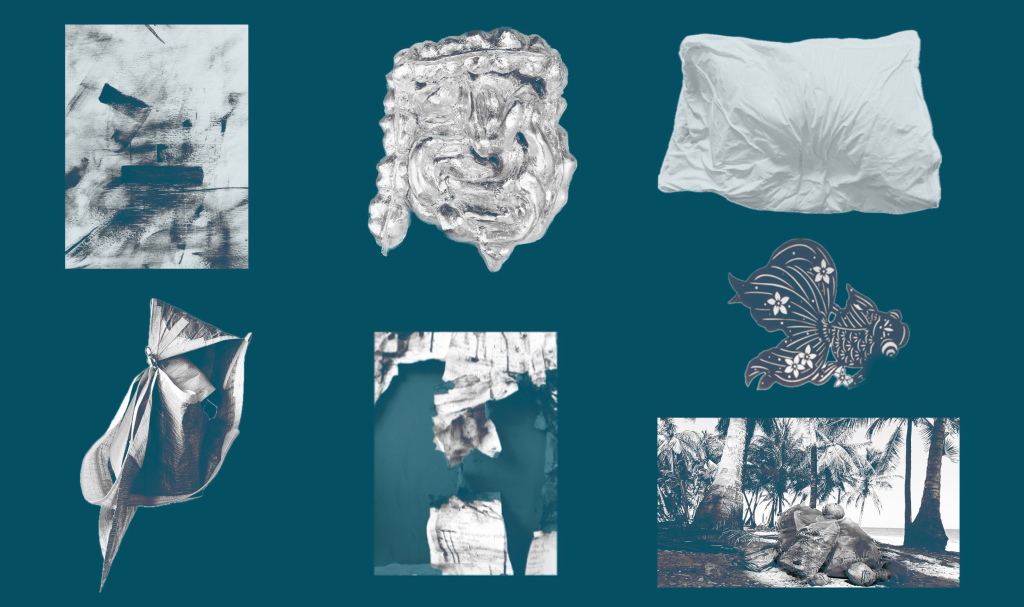
Event Details
When: April 11 | 18:00 - 22:00 Exhibition duration: April 11-May 3, 2025 Opening Hours: Monday-Saturday, 14:00-17:00 | April 23-26, visits upon request Where: ACG Gallery, The American College of Greece, 6,
Event Details
When:
April 11 | 18:00 – 22:00
Exhibition duration: April 11-May 3, 2025
Opening Hours: Monday-Saturday, 14:00-17:00 | April 23-26, visits upon request
Where:
ACG Gallery, The American College of Greece, 6, Gravias Str., Aghia Paraskevi
Organized by:
Visual Arts Program, Frances Rich School of Fine and Performing Arts
Deree – The American College of Greece
About the event
The exhibition Are we there yet? presents us with an impatience, a yearning to arrive, and a knowledge that we are still and always in a state of transformation. Students completing the Visual Arts program have spent a full academic year to research and realize a project related to their specific interests as emerging visual artists.
In this unformed moment between what might be and what is… we find ourselves at sea, swept along by circumstance and unconscious forces. What skills, what magic can keep us of sound body and mind? Students, on the verge of graduating, are marked by the exhaustion of the journey and a restlessness for the new. Their energy, their search for the beautiful amidst the uncertainty and betrayals of the moment, offer the viewer direction and renewal.
Graduating students: Jason Bonas, Ioanna Bounazou, Elsa Eustergerling, Mengda Hu, Fani Koulocheri, Phivi Nicolaou, and Vaggi Sekifu.
Join the opening to see the work and to meet the artists!
About the projects
Jason Bonas, Alter Ego
What should you wear to go sailing? In this installation, Bonas suggests a new uniform for sailing by presenting a series of outerwear, crafted out of sails and other materials sourced from “Alter Ego”, his grandfather’s sailing yacht. Inspired by the mise-en-scène of a sailboat, the work appears as a series of hybrids between space, sculpture and garment that negotiate form, materiality, utility, and status. What kind of self is stitched into these materials?
Ioanna Bounazou, Lines of Liberation
In a series of paintings, Bounazou transforms constraint into freedom. Through expressive colors and dynamic gestures, she traces the journey from structure to spontaneity, inspired by her habit of doodling circles when feeling free and squares when feeling restricted. The paintings reflect the tension between control and release.
Elsa Eustergerling, Pink Funk
Eustergerling creates an immersive installation of personal notes, lists, reminders, and journal entries. Expanding beyond the wall into an abstract sculptural work, the work makes visible her experience with ADHD through its chaotic accumulation of notes, recognizing notetaking as both a coping mechanism and a mark of unseen private labor. By publicizing intimate thoughts, yet concealing some of its contents, Elsa explores the tension between public and private selves, offering a reflection on visibility and control.
Mengda Hu, To see eye to eye
Hu’s shadow installation is inspired by his myopic correction surgery. Using elaborate paper-cuts and light, the feast of shadows and reflections conveys a new way of viewing. Beyond the traditional visual boundaries and surface forms, and beyond the audience’s own metaphorical or physical limitations, Hu invites us to embrace what lies behind in the hidden dimension and to share in the beauty he sees.
Fani Koulocheri, And Now We Wait
Fani Koulocheri examines health and physical healing through anatomical drawings and sculptural invocations of the body. Based on Greek Orthodox tradition, she refers to votive offerings known as “tamata”, while creating a dialogue with contemporary developments in medicine. FK shines a light on health issues considered taboo in modern societies, adorning their “grotesque” qualities. Her collection of artifacts confronts the viewer with the perspective of the patient who strives to cure their condition.
Phivi Nicolaou, Morpheus’ Bed
Mapping the invisible traces of sleep, Nicolaou preserves the fading impressions of the body at rest, revealing sleep as a site of transformation. Morpheus’ bed is a sculptural installation, a visual archive of subconscious movement and unconscious activity; where the mind has been, what remains in the folds, and how sleep marks the body’s presence in absence.
Vaggi Sekifu, Multiple – Single – Use
In the video installation Multiple – Single – Use, we are confronted with the gap between what should happen for the environment and our confidence about whether it will. Multi-year negotiations for a Global Plastics Treaty (INC) are set to conclude this August in Geneva. Though not confirmed, the Galapagos Islands have been proposed to host the signing of the treaty due to their unique biodiversity and vulnerability to plastic pollution. Sekifu’s work highlights single-use consumer culture and places responsibility on those with legislative power through its portrayal of a fictional scenario – one that seems highly unrealistic – in which the “Galapagos Treaty” global ban on the production and use of single-use plastics has been ratified.
For more information, please contact Ms Kladakis at 2106009800 Ext. 1456 or [email protected]
For visit requests please contact Fani Koulocheri at [email protected]