
February, 2026
202624Feb(Feb 24)18:0025Apr(Apr 25)16:00
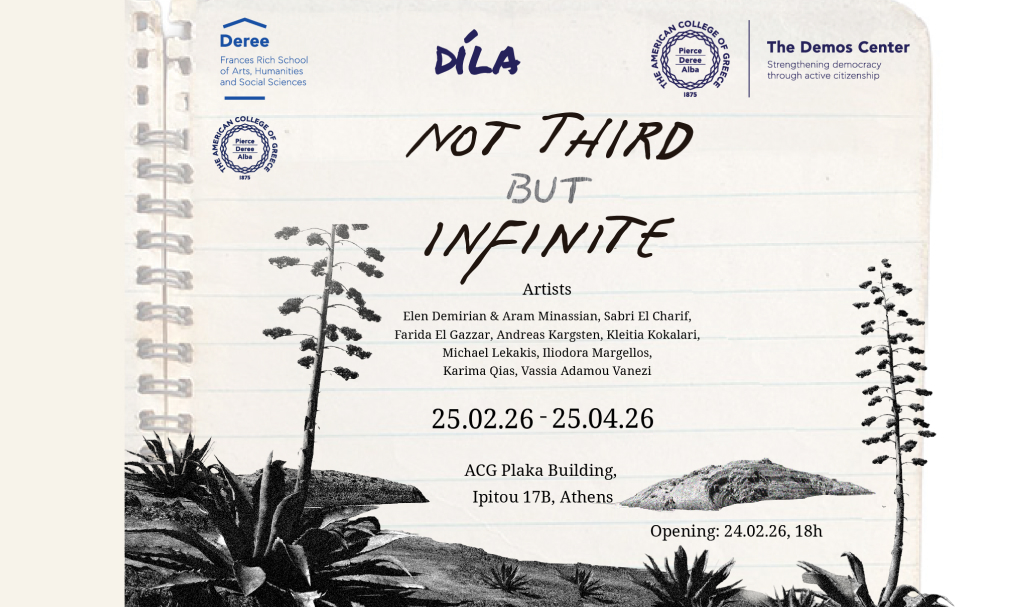
Event Details
Opening: Tuesday, February 24, 2026 | 18:00-21:00
When: February 25-April 25, 2026
Opening hours: Wednesday-Friday: 15:00-19:00 & Saturday: 12:00-16:00
Closed between: April 4-19 for the Easter break
Where: ACG Plaka Building, 17 Ipitou St, Plaka, Athens
Curated by
ACG Art collection in collaboration with Díla
Co-organized by:
Díla
Frances Rich School of Arts, Humanities and Social Sciences, Deree – The American College of Greece
The Demos Center of The American College of Greece
About the exhibition
A new group exhibition brings together artists from diverse cross-cultural backgrounds to explore ideas of dislocation and possibility, alongside expressions of hybridity in relation to place, belonging, and selfhood.
Not Third but Infinite takes its title and conceptual framework from critical theorist Homi K. Bhabha’s notion of the “Third Space,” expanding his idea of a hybrid, imagined zone between cultures into a vision of infinite re-creation. This expansion evokes the psychological potency of utopia—a state defined by perpetual openness and possibility. Notably, the exhibition includes previously unexhibited notebooks and ephemera from the personal archive of the distinguished Greek-American artist Michael Lekakis (1907–1987). Lekakis’s work has been shown at the Metropolitan Museum of Art, MoMA, and the Guggenheim, and is held in the permanent collection of the National Gallery of Greece.
Featuring both established and posthumous artists alongside those at earlier stages of their careers, the exhibition presents poetry, painting, embroidery, works on paper, archival ephemera, and immersive installations. It collectively reflects on what it means not only to leave one’s roots behind, but also to continuously renegotiate versions of the self. These recalibrated identities are often constructed from visual fragments, memories, and sensory impressions tied to specific landscapes and physical touchpoints, which reassemble in unfamiliar yet generative ways. Greek-Egyptian painter Farida El Gazzar, continuing her evolving series of miniature paintings depicting city life, architecture, and foliage, presents scenes drawn from the urban landscapes of Athens and Alexandria, framed within kitsch decorative borders. Greek-Cypriot artist Vassia Adamou Vanezi, who describes her practice as involving “poetic gestures” and “visual poetry or concrete poetry,” engages with the contested terrain of her Cypriot homeland. Through botanicals mounted on handmade paper and layers of typed text rendered illegible through repetition, she enacts processes of confusion, re-creation, and re-meaning.
Of Korean-American origin and raised between Switzerland and Greece, multidisciplinary artist Iliodora Margellos brings her meditative stitch-based practice to her series Securities, presenting embroidered aphorisms such as A Star Is Brighter in the Clear Sky and The Sun Will Always Rise as gestures of reassurance for the untethered self. She also presents two lesser-known installations: a floor-based crochet and mirror sculpture of droplets and puddles, titled Long Quiet River—named after Étienne Chatiliez’s French comedy film “La Vie est un Long Fleuve Tranquille”—and a delicate handwoven mobile, Comforts (Very Knotty) IV, anchored by a textile knot that gestures toward entanglement and the quiet inner harmony one learns to cultivate within the layered complexities of familial identity. Kleitia Kokalari, born in Albania and raised in Athens, contributes paintings of uncanny landscapes suggestive of the subconscious, featuring border waters and a cave-like portal that appears to lead elsewhere. Zigzagging, geometrically carved sculptures by Swedish-born, Athens-based artist Andreas Kargsten punctuate corners and transitional spaces, marking thresholds between the exhibition’s rooms and corridors
Two contributions come from artists associated with Díla, a community offering mentorship to young refugee women pursuing work in the arts, which co-produced Not Third but Infinite. Upon entering the exhibition, visitors encounter a large-scale painting by Elen Demirian, a young Armenian artist currently studying Visual Arts at Deree. Her striking work 499, co-authored with her partner Aram Minassian—also of Armenian origin and now based in France—is densely layered with references to shared cultural memory, including excerpts from prayers, folk songs, and privately coded numerological symbols, together forming an intimate “third space” on the canvas. Further along the corridor, in a room of its own, visitors encounter Chink of Light, a poetry installation by Iran-born writer of Tajik origin Karima Qias, now based in Brussels. Previously installed at Pikionis’ pavilion on Philopappou Hill, the work features calligraphed pages from her handmade book lining the walls, accompanied by a video portrait and a Persian-language poetry audio track.
Text and lyrical language are among the exhibition’s defining elements. Lettering and literary forms appear across media—in collaborative painting, poetry installations, embroidery on paper and cloth, and most prominently in the poems, reflections, and jottings found in Lekakis’s notebooks. Spiritual references to the sky and the stars, with their inherently transnational and borderless qualities, recur throughout the exhibition. In one notebook poem, Lekakis writes:
“What happens to the stars at night?
They fly to Egypt
To crash at the feet of Ra
They pile so high
They slip over the ends of the earth.”
Many of the works seek either to zoom out from the earthly plane in search of broader perspective, or to capture fleeting moments as textures—through words, materials, and gestures—rendering experience tangible even as it slips away. In doing so, they register and commemorate earthly details as both anchors of belonging and points of departure. Despite their diversity of media and individual artistic languages, the works in Not Third but Infinite share an acute awareness of ephemerality and impermanence. Distributed across the ground-floor rooms of the beautifully preserved neoclassical villa of The American College of Greece (ACG) on Ipitou Street, the exhibition unfolds as a collective meditation on dislocation as both rupture and reconstitution. Particularly notable are the archival materials by Lekakis displayed in the main room: personal correspondence, photographs, and notebooks drawn from an archive held by the ACG Art Collection. Presented in traditional library display cases, these informal pages offer intimate insights into the New York–born artist’s life and imaginative world through his distinctive and evocative poetic voice.
Also of special note is a haunting basement installation by Sabri El Charif, a recent graduate of Deree’s Visual Arts Program and a young artist of Egyptian-Levantine origin. His floor-based work Under This Sky pays tribute to the tragedy of the ongoing genocide in Palestine, addressing in particular the mass graves in Gaza as a violent attempt to sever a people from their homeland.
Not Third but Infinite is co-organized by Díla, The Frances Rich School of Arts, Humanities and Social Sciences, The Demos Center of The American College of Greece. As a collaborative endeavor, the exhibition reflects the School’s commitment to offer a wide range of artistic activities and promote its students and graduates, The Demos Center’s mission to foster a sense of active citizenship—particularly among younger generations—as well as Díla’s dedication to supporting young refugee women on creative career paths.
For further clarifications, please contact [email protected]
Participating artists: Elen Demirian & Aram Minassian, Sabri El Charif, Farida El Gazzar, Andreas Kargsten, Kleitia Kokalari, Michael Lekakis, Iliodora Margellos, Karima Qias, Vassia Adamou Vanezi
Curated by: Ioanna Papapavlou and Díla
Exhibition production: Ana S. González Rueda, Katerina Milesi
Graphic Design: Elen Demirian
Gallery texts: Eliana Klathis, Katerina Merkouri, Katerina Milesi, Eva Ntampanli
Special thanks to Dean Helena Maragou, Niki Kladakis, and Dr. Mary Cardaras.
Thanks to Niky Theodorou for logistical assistance, Virna Vrettou, George Papastogiannoudis and Nikolaos Fronimos for the Marketing and PR of the exhibition, Michalis Orontis and the security team, George Kyrodimos, John Fetalidis, Victor Zafeiropoulos, as well as Haris Gialelis, Christos Mantzios, Antonis Kontopoulos, Dimitris Fakinos, Stavros Theofilou, Vasilis Palaiogiannis, Manolis Sideris, Stelios Teloniatis, Giannis Gerakellis, John Poulakis, Stavros Karadimitriou, Alekos Potamianos, Giannis Kontopoulos and Takis Moschidis for the technical support.
