
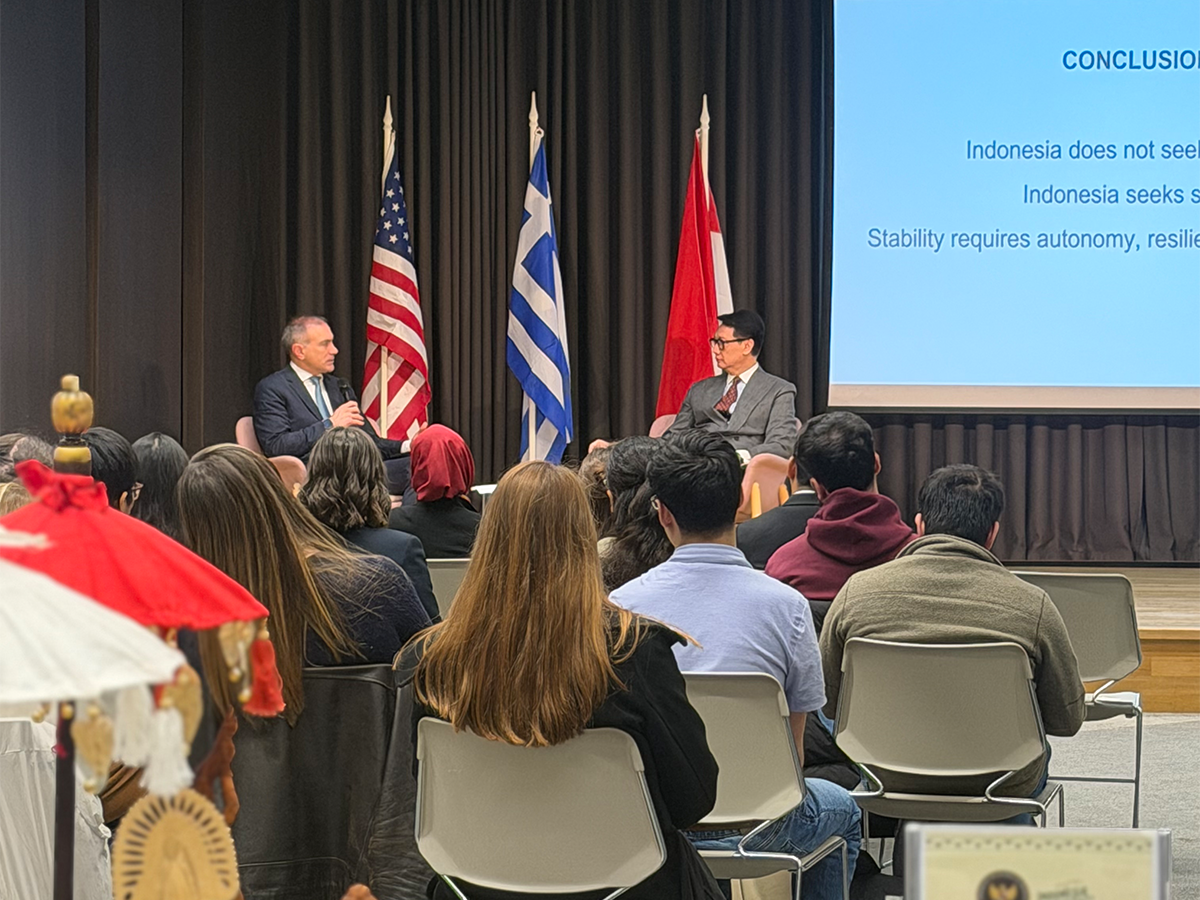
On Thursday, February 12, ACG welcomed the Vice Minister of Foreign Affairs of the Republic of Indonesia, H.E. Ambassador Arif Havas Oegroseno, to the ACG Events Hall for a lecture titled “Global Outlook 2026: Indonesia’s Perspectives.” The Vice Minister was accompanied by H.E. Ambassador Dr. Bebeb A.K. Nugraha Djundjunan and members of the Indonesian delegation. The event, held in the presence of ACG President Ed Wingenbach, brought together Deree students and faculty for a focused discussion on Indonesia’s strategic outlook in a shifting global order.
The session was moderated by Dr. Konstantinos Filis, Director of ACG’s Institute of Global Affairs and Deree Professor of International Relations & European Affairs. In his opening remarks, Dr. Filis noted that in a period of geopolitical fragility, middle powers such as Indonesia play a significant role in shaping regional and global dynamics, operating within complex regional systems, safeguarding strategic autonomy, and shaping outcomes through calibrated engagement. Drawing a parallel with Greece as a maritime nation, he underscored how geography informs national strategy and highlighted the scope for cooperation between Southeast Asia and Europe.
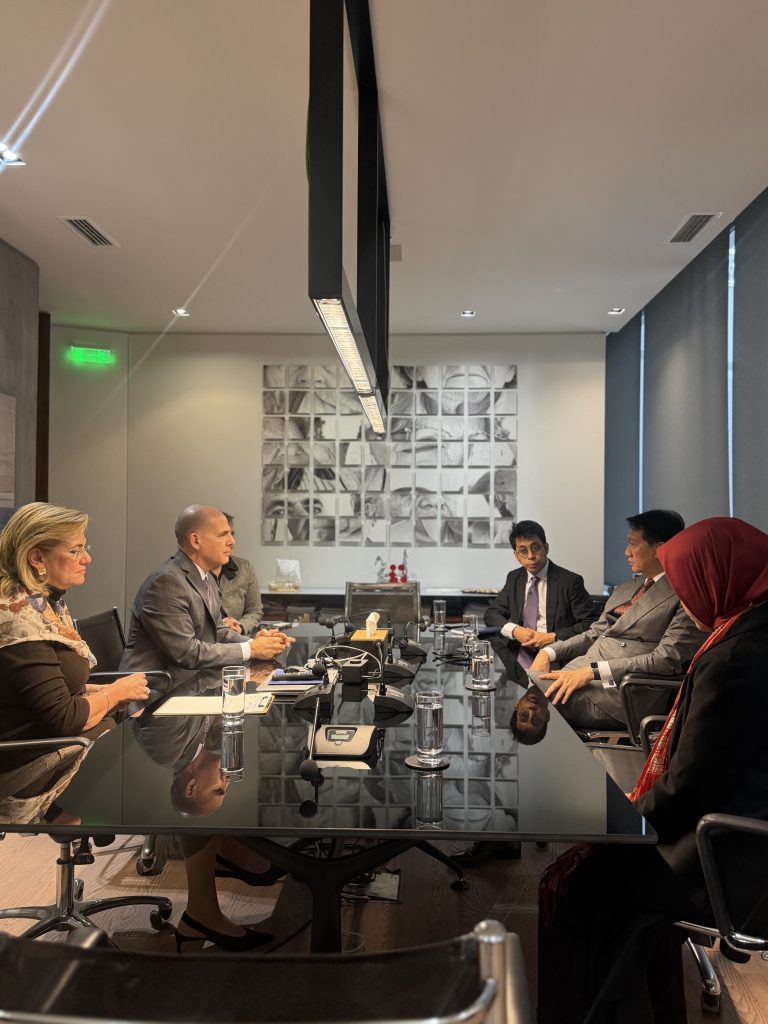
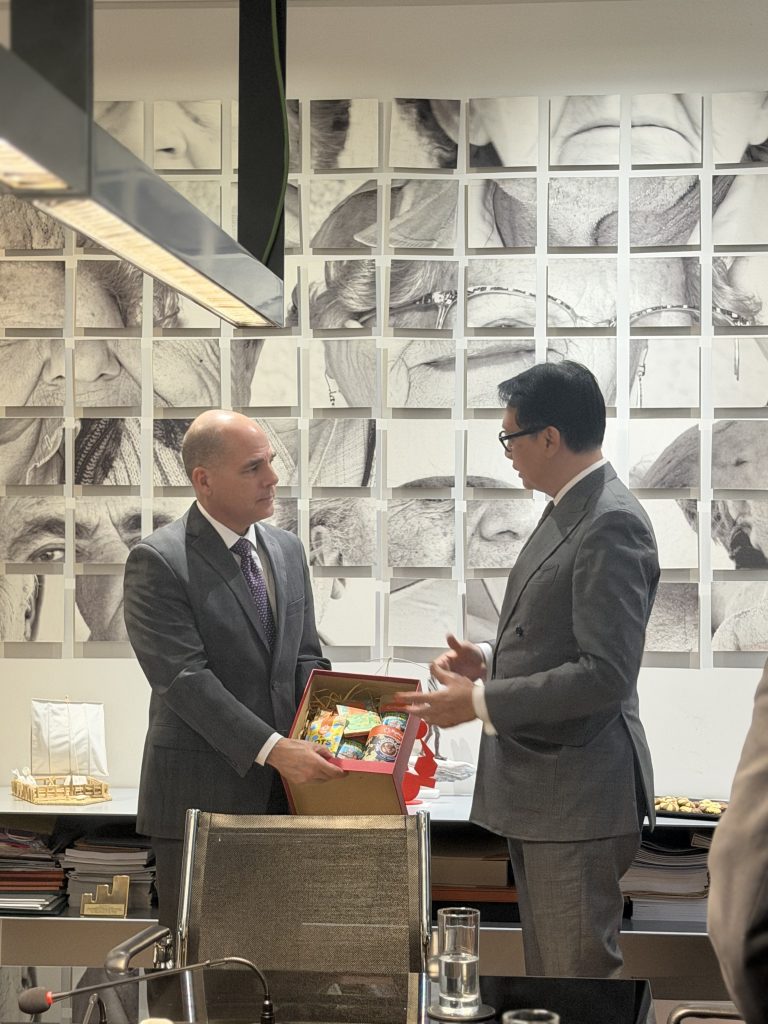
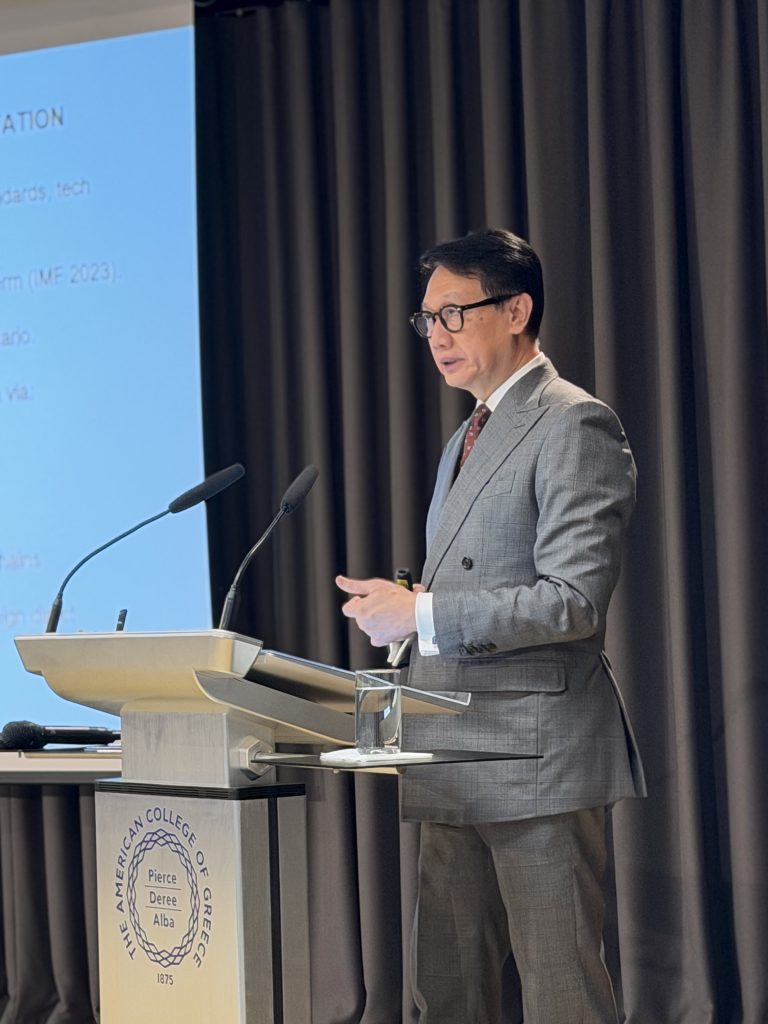
In his presentation, Vice Minister Oegroseno traced Indonesia’s geopolitical evolution from independence in 1945 to the present. He reflected on the archipelagic character of the country—comprising more than 17,000 islands, over 300 ethnic groups and more than 700 languages—and on the unifying force of the 1928 Youth Pledge, which affirmed one motherland, one nation and one language: Indonesia. The concept of Indonesia as a nation of both land and water, he noted, remains central to its identity and strategic outlook.
Indonesia’s foreign policy, he explained, is anchored in the doctrine of being “independent and active.” The country does not align itself with military alliances, nor does it adopt neutrality. Instead, it pursues strategic autonomy grounded in international law, combined with active participation in bilateral, regional and multilateral frameworks. Independence in foreign policy is viewed as essential to safeguarding national interests while contributing to stability.
Positioned along critical maritime corridors, Indonesia sits at the heart of global trade flows. Approximately 40% of global trade passes through the South China Sea, while 25–30% of global maritime trade transits the Strait of Malacca—routes critical to global supply chains and energy security. These routes are vital to energy security and to the continuity of the supply chain in East Asia and beyond, reinforcing Indonesia’s role in maintaining regional stability.
By shifting from raw exports to downstream production, Indonesia has significantly increased export value and aims to share this model with partners in Africa and other regions. In this context, Vice Minister Oegroseno described Indonesia as an initiator and middle power within the Global South, convening forums on critical minerals governance, ocean sustainability, and the needs of archipelagic and island states. Middle-power cooperation, he argued, can help bridge institutional gaps and shape workable governance mechanisms in a multipolar world.
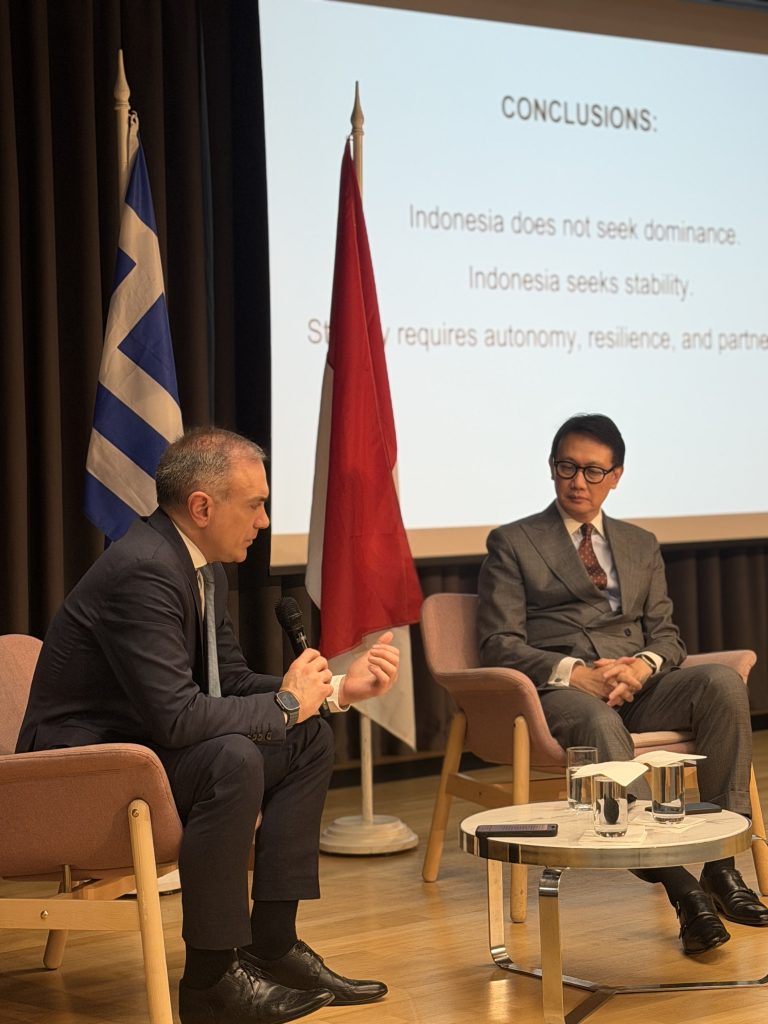
In the discussion with Dr. Filis that followed, Vice Minister Oegroseno described Indonesia’s efforts to diversify trade and investment partnerships, including engagement with Africa, Latin America and Europe. Greece was identified as a strategic partner, particularly in shipping and maritime connectivity, with the potential to strengthen Indonesia’s access to European markets.
The event wrapped up with a Q&A session during which Deree students engaged the Vice Minister on Indonesia’s development priorities and global engagement. Reaffirming that Indonesia seeks not dominance but stability—grounded in autonomy, resilience and partnerships—he outlined major national infrastructure initiatives, including the development of 45 ports, 25 airports, expanded railway networks and irrigation systems to strengthen agricultural capacity. He also addressed Indonesia’s participation in multilateral groupings and emphasized the importance of diversification in an interconnected world where regional developments carry global consequences.
The Vice Minister’s visit provided the ACG community with a substantive exchange on the evolving role of middle powers and reinforced the value of academic dialogue in deepening international understanding.