
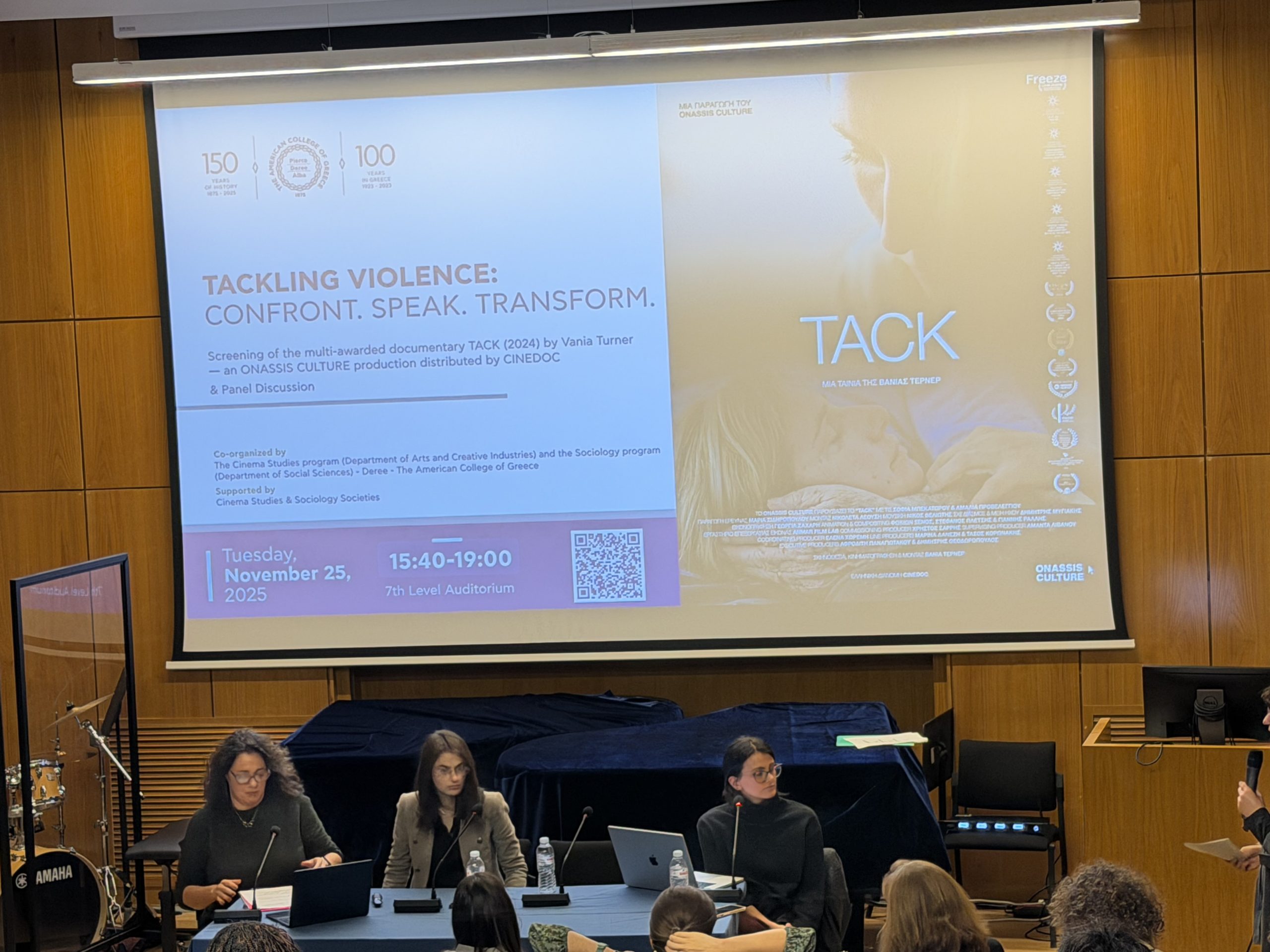
In observance of the International Day for the Elimination of Violence Against Women, the Cinema Studies program (Department of Arts and Creative Industries) and the Sociology program (Department of Social Sciences) at Deree – The American College of Greece co-organized Tackling Violence: Confront. Speak. Transform, a thought-provoking event dedicated to understanding and responding to gender-based violence. The event was supported by the Cinema Studies and Sociology Societies and moderated by Dr. Chryssa Zachou and Artemis Anastasiadou.
Held on November 25 at the 7th Level Auditorium, the evening centered on the screening of TACK (2024), the multi-awarded documentary by filmmaker Vania Turner, produced by ONASSIS CULTURE and distributed by Cinedoc. The film follows Olympian Sofia Bekatorou, whose decision to publicly disclose her experience of sexual abuse ignited Greece’s #MeToo movement, as she supports Amalia, a young athlete pursuing justice in her own case. Turner’s sensitive and deeply human approach illuminated the emotional weight carried by survivors and their families, while also highlighting the political urgency behind their stories.
Following the screening, a panel of distinguished experts—Vania Turner, Dr. Foteini Sonia (Tinia) Apergi, Dr. Chara Chioni Chotouman, and Dr. Myrna Papadouka—engaged in an interdisciplinary discussion exploring the ethical, legal, psychological, and sociological dimensions of violence, trauma, and justice.
Turner described the ethical framework underpinning her work with vulnerable populations, emphasizing free and informed consent, the duty of care, and the need to counteract the intrinsic power imbalance between filmmaker and subject. She explained how building sustained, transparent relationships creates the safety necessary for survivors to reclaim their narratives.
Dr. Apergi examined the psychological realities of disclosure, procedural trauma, and institutional betrayal, outlining how fragmented memory, anxiety, and fear shape survivors’ experiences in systems that often demand clarity and emotional composure. She underscored that trauma-informed justice requires safety, empowerment, trustworthiness, and cultural and gender sensitivity.
From a legal standpoint, Dr. Chioni Chotouman highlighted ongoing challenges in Greece’s evolving definition of consent, statutory limitations on rape cases, and the urgent need for victim- and gender-sensitive judicial practice. She stressed how gaps in legal frameworks continue to burden survivors while benefiting perpetrators.
Dr. Papadouka addressed the broader sociological landscape, noting how Greece’s #MeToo movement generated unprecedented public demand for accountability, even as systemic responses remained largely symbolic. Low reporting rates, undertrained police units, and persistent cultural norms around masculinity continue to hinder effective institutional intervention.
Together, the speakers illuminated the complex intersections of personal trauma and social systems, inviting participants to reflect on ethical representation, survivor advocacy, and collective responsibility in confronting gender-based violence.
The event concluded with an engaging Q&A session, further reinforcing the need for sustained dialogue, critical reflection, and supportive community engagement.